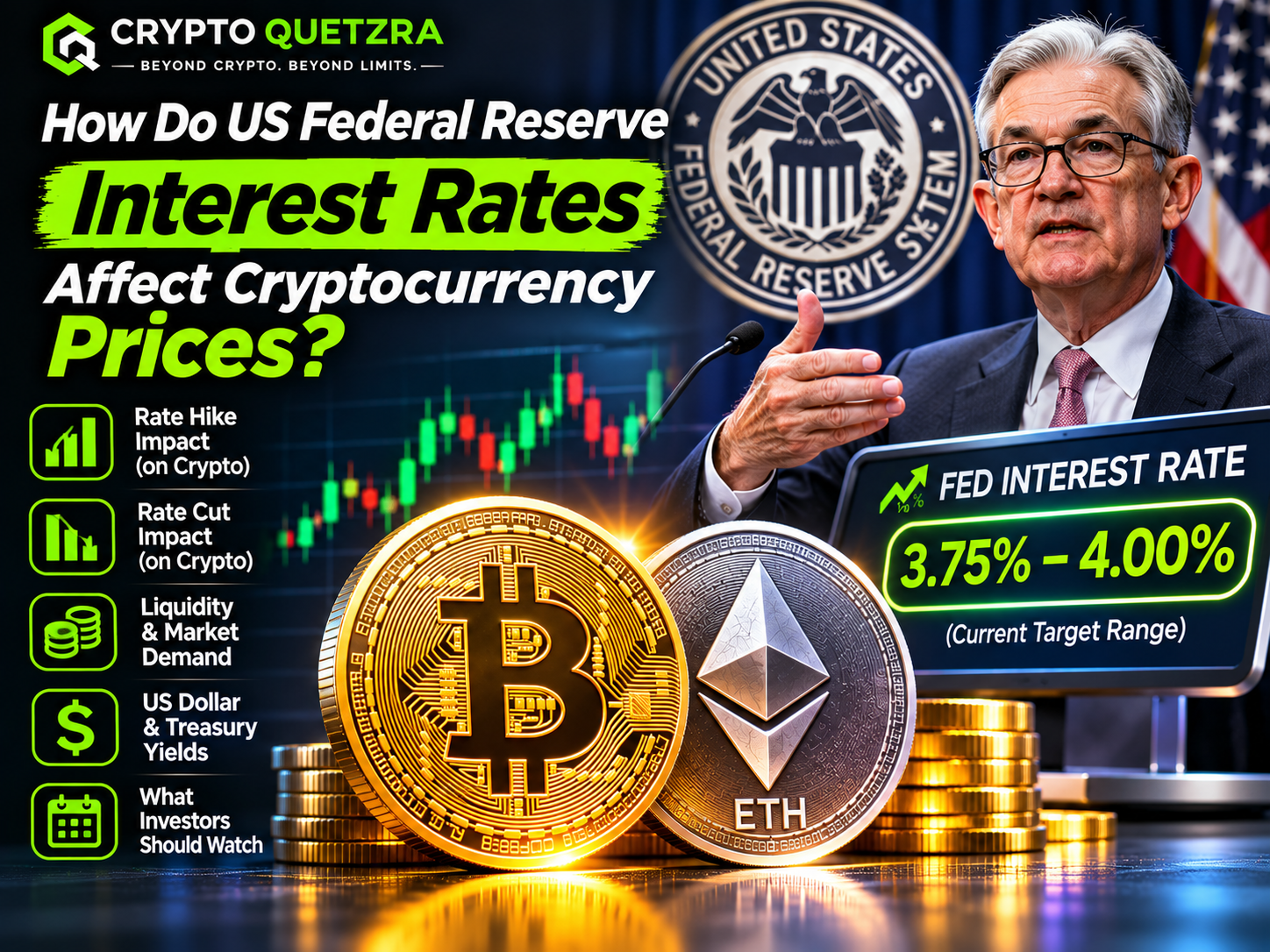
When the US Federal Reserve raises or lowers interest rates, the effects can reach far beyond traditional banking and stock markets. Bitcoin, Ethereum, and other cryptocurrencies can also respond as investors reconsider where to put their money. But why does a decision made by the Federal Reserve influence a market that operates independently of traditional central banks? Understanding the connection between interest rates, market liquidity, the US dollar, and investor confidence can help cryptocurrency investors make better sense of sudden market movements.
Have you ever noticed Bitcoin moving sharply after an announcement from the US Federal Reserve?
It might seem unusual.
Bitcoin was designed to operate without depending on a central bank, and its supply schedule is not controlled by decisions made in Washington. Yet announcements from the Federal Reserve can influence cryptocurrency prices, sometimes within minutes.
The reason is that cryptocurrency markets do not operate separately from the global financial system.
Investors who purchase Bitcoin or Ethereum are often the same people who follow stock markets, interest rates, inflation reports, and currency movements. When the financial environment changes, their investment decisions can change as well.
For example, higher interest rates can make traditional financial products more attractive relative to speculative assets. Lower borrowing costs can encourage investors to take additional risks, potentially supporting demand for cryptocurrencies.
However, the relationship is not always straightforward. Sometimes Bitcoin rises after a rate increase, while on other occasions it falls after a rate cut.
To understand why this happens, we first need to look at what the Federal Reserve actually controls.
1. What Is the US Federal Reserve and Why Does It Matter?
The Federal Reserve, commonly called the Fed, is the central banking system of the United States.
Its monetary policy decisions influence financial conditions throughout the American economy and can affect financial markets around the world.
The Federal Reserve has two main policy goals, commonly known as its dual mandate:
- Maximum sustainable employment.
- Stable prices.
To support these objectives, the Federal Open Market Committee (FOMC) makes decisions about the direction of US monetary policy.
One of its most important tools is setting a target range for the federal funds rate.
What Is the Federal Funds Rate?
The federal funds rate is the interest rate at which banks lend reserve balances to one another overnight.
The Fed establishes a target range and uses its monetary policy tools to guide the effective federal funds rate toward that range.
This rate influences other borrowing and lending rates throughout the financial system.
For example, changes in monetary policy can affect:
- Business borrowing costs.
- Consumer credit conditions.
- Savings rates.
- Government bond yields.
- Mortgage rates.
- Financial market liquidity.
- Investor appetite for riskier assets.
These effects help explain why a decision about overnight bank lending can eventually influence the price of Bitcoin.
What Is the Current Federal Funds Rate in November 2026?
According to the Federal Reserve’s official policy-rate dashboard, the target range was 3.75% to 4.00% as of October 29, 2026.
This is important context when evaluating current cryptocurrency market conditions.
However, the target rate alone does not tell you whether the next Federal Reserve decision will support or pressure Bitcoin.
Investors also consider inflation, employment, economic growth, and the Fed’s expectations for future monetary policy.
2. How Do Interest Rates Affect Cryptocurrency Prices?
The connection between interest rates and cryptocurrency prices mainly operates through financial conditions and investor behavior.
When interest rates rise, borrowing becomes more expensive and relatively safer investments may offer more attractive returns.
When interest rates fall, borrowing costs can decrease and investors may become more willing to explore assets with greater potential returns.
Let’s examine these two situations.
When the Federal Reserve Raises Interest Rates
A rate increase is generally considered a tightening of monetary policy.
It can affect cryptocurrency markets through several channels.
Higher Returns From Traditional Investments
When interest rates increase, savings products and short-term government securities may offer better returns.
Investors who previously considered Bitcoin or other speculative assets may decide that traditional financial products offer a more attractive balance between risk and return.
This can reduce demand for cryptocurrencies.
More Expensive Borrowing
Businesses and households may face higher borrowing costs.
Investors who use borrowed money to purchase financial assets can become more cautious.
Some leveraged cryptocurrency traders may also reduce their positions because maintaining borrowed exposure becomes more expensive.
Reduced Risk Appetite
When financial conditions become tighter, investors may prefer assets they consider more stable.
Bitcoin and many other cryptocurrencies can experience selling pressure as investors reduce exposure to volatile investments.
Pressure on Market Liquidity
Tighter monetary policy can reduce the availability or attractiveness of credit throughout the financial system.
When financial conditions become less supportive, speculative investment demand can weaken.
This can affect cryptocurrency markets because digital assets depend heavily on investor demand and available market liquidity.
When the Federal Reserve Cuts Interest Rates
A rate reduction is generally associated with easier monetary policy.
Lower interest rates can create a different financial environment.
Traditional Savings May Become Less Attractive
When interest rates decline, some traditional savings and short-term investment products may offer lower returns.
Investors searching for higher potential returns might become more interested in equities, technology companies, and cryptocurrencies.
Borrowing May Become Cheaper
Lower borrowing costs can encourage businesses and households to spend and invest.
If financial conditions improve, investors may become more willing to allocate money toward higher-risk assets.
Improved Investor Confidence
If interest-rate cuts are accompanied by stable economic conditions and improving inflation, investors may become more optimistic.
That environment can support cryptocurrency demand.
Potentially Better Liquidity Conditions
Easier monetary policy can support broader financial conditions, although it does not guarantee that every investor or financial institution will increase cryptocurrency exposure.
The important point is that lower interest rates can create favorable conditions for cryptocurrency markets, but the market response depends on the wider economic situation.