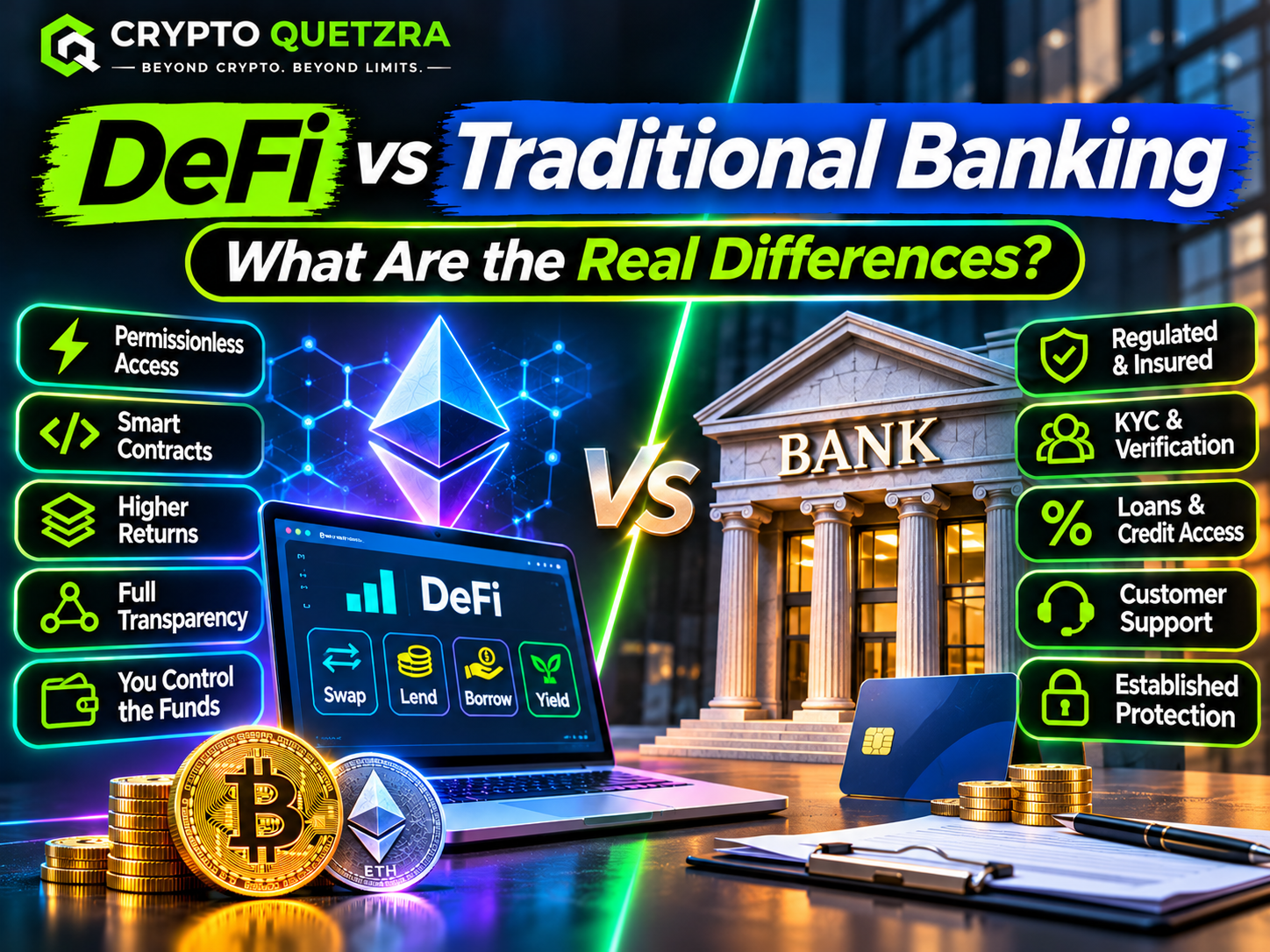
Traditional banks have controlled much of the world’s financial activity for generations. But decentralized finance, commonly known as DeFi, is introducing another way to save, borrow, lend, and transfer money. Instead of depending entirely on banks and financial institutions, DeFi uses blockchain networks and smart contracts to execute financial transactions. But does that make it better than traditional banking? Let’s explore the real differences, costs, benefits, security risks, and what each system offers to everyday users.
Imagine needing to transfer money to someone in another country.
With traditional banking, you might need to use your bank’s international transfer service, provide payment details, pay a fee, and wait for the transaction to move through the relevant financial institutions.
Now imagine performing a cryptocurrency transaction using a blockchain application. You connect your digital wallet, enter the recipient’s address, approve the transaction, and submit it to the network.
The experience can feel completely different.
One system relies on financial institutions, regulated payment providers, and established banking infrastructure. The other uses blockchain technology and programmable financial agreements to perform certain activities without requiring a traditional bank to approve every transaction.
This is the basic difference between traditional finance and decentralized finance.
However, the comparison is not as simple as saying that DeFi is modern and banks are outdated.
Traditional banking provides important services such as insured deposits, regulated lending, consumer protection, and customer support.
DeFi offers different advantages, including programmable transactions, open blockchain infrastructure, and the possibility of interacting with financial protocols without opening a conventional bank account.
Both systems have opportunities and weaknesses.
Understanding how they actually work is more useful than deciding which one sounds more innovative.
1. What Is Traditional Banking?
Traditional banking is the financial system built around regulated banks and other financial institutions.
Banks accept deposits, process payments, provide loans, manage accounts, and offer financial products to individuals and businesses.
When you deposit money into a bank account, the institution records the balance it owes you as a deposit liability.
The bank manages its assets and liabilities while operating under applicable banking regulations and supervisory requirements.
How Does Traditional Banking Work?
Consider a simple example.
You deposit $1,000 into a bank account.
The bank records your deposit and provides access to services such as withdrawals, transfers, and payments.
You can use your debit card, transfer funds to another account, or withdraw money through an available banking channel.
If you later apply for a personal loan, the bank may evaluate:
- Your income.
- Your employment history.
- Your credit history.
- Your existing debts.
- Your repayment ability.
- Your financial documents.
Based on its lending policies and applicable regulations, the bank decides whether to approve your application and what interest rate to offer.
This system depends on institutional processes, financial records, regulations, and human or automated decision-making.
Main Services Provided by Traditional Banks
Banks typically offer:
Savings and Checking Accounts: Customers can hold money and access it through banking services.
Personal Loans: Individuals can borrow money for personal expenses and other approved purposes.
Business Loans: Companies can obtain financing for operations, equipment, expansion, and investment.
International Transfers: Banks and payment providers help move money between countries.
Debit and Credit Cards: Customers can make payments through established card networks.
Financial Protection: Eligible deposits may receive protection under government-backed deposit insurance or similar national arrangements.
Traditional banks therefore provide more than a place to store money. They form an important part of the wider financial infrastructure.
2. What Is Decentralized Finance (DeFi)?
Decentralized finance, or DeFi, refers to financial applications that use blockchain networks and smart contracts to provide services such as lending, borrowing, trading, and asset management.
Instead of relying entirely on a bank or centralized financial company to manage transactions, these applications use programmable contracts that execute according to predefined rules.
A smart contract is software deployed on a blockchain.
It can hold digital assets, verify specific conditions, and execute transactions when those conditions are met.
For example, a decentralized lending application can allow users to deposit cryptocurrency into a lending pool.
Other users can borrow from that pool by providing the required collateral.
The protocol manages important parts of the transaction through smart contracts.
How Does DeFi Work?
Imagine you own Ethereum and want to use some of its value to borrow a stablecoin.
You connect a compatible cryptocurrency wallet to a decentralized lending application.
The application interacts with a smart contract, which applies the protocol’s rules.
Depending on the platform, the process may involve:
- Depositing eligible cryptocurrency as collateral.
- Checking the current collateral value.
- Calculating the amount you can borrow.
- Confirming the borrowing terms.
- Sending the borrowed assets to your wallet.
The protocol can monitor the collateral position automatically.
If its value falls below a required threshold, the smart contract may liquidate some or all of the collateral according to its rules.
This process does not require a traditional loan officer to manually approve every transaction.
However, the system still depends on blockchain infrastructure, accurate price information, smart contract security, and the economic design of the protocol.
DeFi is therefore not free from intermediaries in every practical sense. Wallet providers, infrastructure companies, stablecoin issuers, protocol administrators, and other service providers may still play important roles.
Official overview: https://ethereum.org/defi/
3. DeFi vs Traditional Banking: Main Differences
The two systems perform several similar financial functions, but their underlying structures are different.
Here is a direct comparison.
| Feature | Traditional Banking | Decentralized Finance |
|---|---|---|
| Main infrastructure | Banks and financial institutions | Blockchain networks and smart contracts |
| Account access | Usually requires registration and identity verification | Often requires a compatible wallet |
| Financial records | Centralized institutional databases | Distributed blockchain records |
| Transaction processing | Bank and payment systems | Smart contracts and blockchain validators |
| Operating hours | Services and markets may have scheduled hours | Many protocols operate continuously |
| Loan approval | Credit history, income, and underwriting | Often based on cryptocurrency collateral |
| Interest rates | Set by institutions and market conditions | Often determined by protocol rules and supply and demand |
| Asset custody | Bank or financial institution holds deposits | Users may control their own private keys |
| Customer support | Formal support and complaints processes | Varies by application and protocol |
| Regulation | Established financial regulatory frameworks | Varies by jurisdiction and service structure |
| Deposit protection | May apply to eligible bank deposits | Usually no equivalent government deposit insurance |
| Main risks | Bank, credit, operational, and counterparty risks | Smart contract, market, liquidity, custody, and protocol risks |
The important distinction is that traditional banking relies on regulated institutions, while DeFi attempts to automate and distribute certain financial functions through blockchain technology.
Neither system completely eliminates trust.
They simply place trust in different areas.
4. Who Controls Your Money: Banks vs DeFi?
One of the biggest differences between the two financial systems is control over assets.
In traditional banking, your deposit is generally a claim against the bank.
The bank maintains records of your balance and processes withdrawals according to its terms, applicable laws, and regulatory requirements.
In self-custody DeFi, you can control the private keys associated with your cryptocurrency wallet.
This means you can authorize blockchain transactions without asking a traditional bank to approve every transfer.
Traditional Banking: Institutional Custody
When you deposit money in a bank, you rely on the institution to manage your account and provide access to your funds.
The bank maintains the systems responsible for recording balances and processing transactions.
This creates convenience because customers do not need to manage the technical infrastructure themselves.
However, account access can be affected by fraud checks, legal requirements, account restrictions, operational problems, or other banking procedures.
DeFi: Self-Custody
With a self-custody wallet, you control the private keys required to authorize transactions.
You do not need a traditional bank to hold your cryptocurrency.
However, this creates additional responsibility.
If you lose your recovery phrase or accidentally expose your private keys, recovering your assets may be impossible.
There is no ordinary bank representative who can reset access to a self-custody wallet.
This is why DeFi offers greater direct control but also places more security responsibility on the user.
5. How Are Payments and Transfers Different?
Payments are one of the most familiar financial activities, making them a useful way to compare both systems.
Traditional Bank Transfers
Traditional banks use payment networks and financial institutions to move money between accounts.
Domestic payments can be completed relatively quickly through modern payment systems.
However, international transfers may involve several institutions, currency conversions, intermediary fees, and additional verification.
The actual processing time depends on the countries, payment method, and banking providers involved.
DeFi Transactions
DeFi transactions are submitted to blockchain networks.
A user connects a wallet, authorizes a transaction, and broadcasts it to the network.
Validators or other network participants process transactions according to the blockchain’s consensus rules.
Many transactions can be completed without a conventional international bank transfer process.
However, users still need to consider:
- Blockchain transaction fees.
- Network congestion.
- Confirmation time.
- Wallet compatibility.
- Exchange-rate movements.
- Receiving address accuracy.
Blockchain transfers are not automatically free or instant.
A busy network can experience delays or higher fees, and a transaction sent to the wrong address may be extremely difficult to recover.
An Important Difference: Reversibility
Traditional banking and card-payment systems may provide dispute, recall, or chargeback procedures in certain circumstances.
These protections depend on the payment type and applicable rules.
Blockchain transactions are generally designed to be irreversible after confirmation.
If you send cryptocurrency to an incorrect address or approve a malicious transaction, there may be no practical recovery process.
This is an important security consideration for new DeFi users.
6. DeFi Lending vs Traditional Bank Loans
Lending is one of the clearest examples of how the two systems differ.
Both traditional banks and DeFi protocols allow people to access borrowed money.
However, the way they evaluate borrowers is significantly different.
How Traditional Bank Lending Works
When you request a personal loan, the bank typically examines your financial situation.
It may evaluate your salary, income stability, credit history, outstanding obligations, and repayment ability.
A good credit history can improve your chances of receiving approval and potentially obtaining better loan terms.
The bank accepts credit risk because the borrower is expected to repay the loan over time.
How DeFi Lending Works
Many DeFi lending protocols use cryptocurrency collateral rather than traditional credit underwriting.
For example, imagine depositing cryptocurrency worth $10,000 into a lending protocol.
Depending on its rules, the platform might allow you to borrow a smaller amount of stablecoins against that collateral.
The smart contract monitors the collateral position using the protocol’s pricing system.
If the collateral value falls significantly, the protocol may liquidate assets to protect lenders.
This is different from a traditional unsecured personal loan.
Why Do DeFi Protocols Often Require Overcollateralization?
Cryptocurrency prices can move rapidly.
A borrower might receive a loan today, but the value of the deposited cryptocurrency could fall sharply tomorrow.
Overcollateralization provides a buffer against price changes.
It means the borrower deposits assets worth more than the amount borrowed.
However, this does not remove all risk. Sudden market movements, liquidity shortages, oracle problems, and smart contract vulnerabilities can still create losses.
Which System Is Better for Borrowing?
Traditional banking can be more suitable for people who need loans based on income and creditworthiness rather than cryptocurrency holdings.
DeFi may appeal to people who already own eligible digital assets and want to borrow without going through conventional credit approval.
Neither option is automatically cheaper.
Always compare total borrowing costs, collateral requirements, repayment conditions, and potential penalties.
7. Interest Rates: How Do Banks and DeFi Determine Them?
Interest rates work differently in traditional banking and decentralized finance.
Traditional Banking Interest Rates
Banks generally determine borrowing and deposit rates using several factors.
These can include:
- Central bank monetary policy.
- Market funding costs.
- Inflation expectations.
- Borrower credit risk.
- Loan duration.
- Competition between financial institutions.
- Regulatory and capital requirements.
For example, when central banks raise benchmark rates, banks may increase borrowing rates for customers.
The actual effect depends on the type of loan and the bank’s pricing decisions.
DeFi Interest Rates
In many DeFi lending protocols, interest rates change according to the supply of deposited assets and demand for borrowing.
Imagine a lending pool containing stablecoins.
If many users deposit funds but relatively few people borrow, the borrowing rate may decrease.
If borrowing demand rises while available liquidity becomes limited, the rate may increase.
This process can be managed by algorithms written into smart contracts.
Why Can DeFi Rates Change So Quickly?
DeFi protocols often adjust rates according to utilization.
Utilization refers to the proportion of available lending liquidity that borrowers are using.
When more available funds are borrowed, the protocol may increase interest rates to encourage additional deposits and discourage excessive borrowing.
This creates a market-driven mechanism, although protocol designers determine the formulas and parameters.
An advertised DeFi yield should never be assumed to remain constant.
Rates can change quickly as liquidity conditions change.
8. Are DeFi Transactions More Transparent Than Traditional Banking?
Transparency is one of the strongest arguments for decentralized finance.
Public blockchains allow people to inspect transaction records through blockchain explorers and other analysis tools.
For supported networks, users can examine wallet activity, contract interactions, and transfers without asking a bank for internal transaction records.
This provides a different level of public verifiability.
Blockchain Transparency
Many DeFi protocols use publicly accessible smart contracts.
Users and developers can examine contract code, transaction history, and protocol activity.
This can make certain financial operations easier to audit independently.
However, transparency does not mean that everything is easy to understand.
Most users cannot independently review complex smart contract code or determine whether a protocol contains an economic vulnerability.
Traditional Banking Transparency
Banks maintain internal ledgers and transaction records.
Customers can access statements, account histories, and other information relevant to their accounts.
However, ordinary customers generally cannot inspect every internal bank transaction or view the entire institution’s financial activity in real time.
Banks instead operate under accounting, auditing, disclosure, and supervisory requirements.
Does Transparency Make DeFi Safer?
Not necessarily.
A publicly visible smart contract can still contain a serious vulnerability.
An attacker may exploit a weakness that remains unnoticed until funds have already been lost.
Transparency helps independent review, but it does not replace security audits, proper governance, and careful risk management.
9. Is DeFi More Accessible Than Traditional Banking?
Accessibility is another reason DeFi attracts attention.
Traditional banking services often require users to complete identity verification and satisfy eligibility requirements.
Depending on the financial product, applicants may also need proof of income, residence, employment, or credit history.
DeFi applications generally have different entry requirements.
A person with an internet connection, a compatible wallet, and the required digital assets may be able to interact with a permissionless protocol.
This can provide access to financial applications without opening a conventional bank account.
However, there are practical limitations.
Advantages of DeFi Accessibility
- Many protocols are accessible online.
- Some services do not require conventional credit checks.
- Users can interact directly with smart contracts.
- Geographic access may be broader than that of certain banking products.
- Small digital transactions may be possible.
Limitations of DeFi Accessibility
- Users need internet access and technical knowledge.
- Cryptocurrency acquisition may be difficult in some countries.
- Transaction fees can create barriers.
- Applications may not support every region or asset.
- Wallet management can be confusing for beginners.
- Local regulations may restrict certain activities.
- Stablecoin access may depend on issuers and centralized services.
Permissionless access also does not mean that every DeFi service is exempt from financial regulation.
The legal responsibilities of developers, operators, service providers, and users can differ by jurisdiction.
10. Security: Which System Offers Better Protection?
Security should be one of the most important considerations when comparing traditional banking and DeFi.
Both systems face serious threats, but the nature of those threats is different.
Traditional Banking Security
Banks generally use multiple security measures to protect customer accounts.
These may include:
- Identity verification.
- Fraud detection.
- Transaction monitoring.
- Account authentication.
- Data encryption.
- Regulatory supervision.
- Internal financial controls.
- Customer dispute procedures.
If an account experiences unauthorized activity, customers may have access to formal reporting and dispute processes.
The exact protection depends on local laws, account agreements, and the nature of the transaction.
In the United States, eligible deposits at FDIC-insured banks receive coverage up to $250,000 per depositor, per insured bank, for each ownership category.
This protection applies to eligible bank deposits, not cryptocurrency assets.
Other countries have different deposit-protection systems and limits.
DeFi Security
DeFi uses cryptographic systems, smart contracts, blockchain networks, and digital wallets.
These technologies provide different security advantages, but they also introduce new risks.
Important threats include:
Smart Contract Exploits
A vulnerability in a smart contract may allow an attacker to manipulate the protocol or steal deposited assets.
Wallet Phishing
Fraudulent websites may trick users into revealing recovery phrases or approving malicious transactions.
Private Key Theft
If someone obtains the private keys controlling your wallet, they may be able to transfer your cryptocurrency.
Oracle Manipulation
Many financial protocols use external price information to determine collateral values and execute financial rules.
An incorrect or manipulated price feed can create serious problems.
Protocol Failure
A decentralized application may suffer from coding errors, governance failures, liquidity shortages, or other operational problems.
Liquidation Risk
A rapid decline in collateral value can trigger automatic liquidation, potentially causing borrowers to lose part or all of their deposited assets.
Which Is Safer?
Traditional banking generally offers a more established system of consumer protection, regulatory supervision, and financial recourse.
DeFi offers direct access and programmable control, but users often assume more responsibility for custody and technical risks.
Neither system is entirely free of security problems.
The safest choice depends on what protection you need and how much responsibility you are prepared to manage.
11. Do Banks Have Deposit Insurance While DeFi Does Not?
Deposit protection is one of the most important differences that everyday users should understand.
In many countries, eligible bank deposits are protected by government-backed or legally established deposit insurance schemes.
These systems are designed to protect qualifying depositors when a covered bank fails, subject to specific limits and conditions.
For example, US FDIC insurance protects eligible deposits at insured banks.
DeFi does not generally provide an equivalent government-backed deposit insurance arrangement for cryptocurrency deposited into smart contracts.
If a decentralized lending protocol is exploited or becomes insolvent in economic terms, users may lose some or all of their deposited cryptocurrency.
A smart contract does not automatically provide compensation.
What About Stablecoins?
Some DeFi applications use stablecoins to represent dollar-linked value.
However, holding a stablecoin is not the same as holding an insured US bank deposit.
Stablecoins may involve issuer reserves, redemption policies, banking partners, regulatory requirements, and operational risks.
Even a stablecoin designed to maintain a one-dollar value can trade below that value during periods of market stress.
Always investigate the issuer, reserve arrangements, redemption rules, and legal protections before relying on a stablecoin.
12. Can DeFi Replace Traditional Banking?
DeFi has introduced new ways to perform financial activities, but replacing the entire banking system is a much larger challenge.
Traditional banks provide a wide range of services that extend beyond sending money or lending cryptocurrency.
These include:
- Salary processing.
- Business credit.
- Mortgage financing.
- Cash management.
- Trade finance.
- Regulated payment services.
- Consumer protection.
- Financial compliance.
- Deposit accounts.
- Liquidity support.
DeFi currently offers alternatives for selected activities, including cryptocurrency lending, decentralized trading, tokenized assets, and blockchain-based payments.
But many protocols operate primarily within the cryptocurrency ecosystem.
They do not automatically provide everything a customer needs from a conventional bank.
There is also a difference between technical automation and real-world accountability.
When something goes wrong with a bank account, customers generally have a formal institution and established legal channels to contact.
With a DeFi protocol, the situation may be more complicated because the application could involve anonymous developers, decentralized governance, smart contracts, and multiple independent infrastructure providers.
The future may therefore involve a combination of traditional finance and blockchain-based systems rather than one completely replacing the other.
13. What Are Real-World Uses of DeFi Today?
DeFi is not limited to cryptocurrency speculation.
Several applications attempt to solve real financial problems through blockchain-based infrastructure.
Decentralized Exchanges
Decentralized exchanges allow users to trade supported digital assets through smart contracts and liquidity pools.
Instead of submitting every trade through a conventional centralized exchange operator, users interact with blockchain-based protocols.
Examples include Uniswap and Curve.
These systems introduce risks involving smart contracts, liquidity, slippage, and token prices.
Decentralized Lending
Protocols such as Aave and Compound allow eligible users to supply cryptocurrency and borrow against collateral.
Interest rates are generally influenced by supply, demand, and protocol parameters.
Stablecoin Payments
Stablecoins can be used to transfer blockchain-based value represented by tokens designed to track traditional currencies.
They may support international payments, trading, and access to certain digital financial services.
However, stablecoin transactions still involve blockchain fees and issuer-related risks.
Tokenized Assets
Some blockchain platforms support tokenized representations of financial assets.
This can include products linked to securities, funds, and other real-world assets.
The legal rights attached to a tokenized asset depend on its structure and applicable law.
A token that represents an asset does not automatically give its holder the same protections as direct ownership of that asset.
Yield and Liquidity Provision
Some protocols allow participants to supply digital assets to liquidity pools.
Participants may receive a portion of trading fees or other protocol rewards.
However, they can experience impermanent loss, market volatility, smart contract exploits, and other risks.
These activities should not be confused with guaranteed bank savings returns.
14. DeFi vs Traditional Banking: Which Is Better for Different Users?
There is no single answer that applies to everyone.
Your choice depends on your financial needs, technical knowledge, risk tolerance, and access to services.
Traditional Banking May Be Better If You:
- Need a regular salary or business account.
- Want access to conventional personal loans.
- Require an established consumer complaint process.
- Need debit and credit card services.
- Prefer regulated savings products.
- Want eligible deposits protected by a deposit insurance scheme.
- Do not want to manage private keys.
DeFi May Be Interesting If You:
- Already understand cryptocurrency wallets.
- Want to interact with blockchain financial applications.
- Need access to certain digital asset lending markets.
- Prefer direct wallet-based transactions.
- Want to examine publicly available blockchain records.
- Are comfortable managing private keys and smart contract risks.
- Understand the difference between staking, lending, and liquidity provision.
It is also possible to use both systems.
For example, someone can maintain a conventional bank account for salary payments and everyday expenses while using a self-custody wallet for carefully managed blockchain activities.
The two systems do not have to be mutually exclusive.
15. What Should Beginners Understand Before Using DeFi?
DeFi can look simple when presented through a modern website, but the underlying financial and technical systems can be complicated.
Before depositing cryptocurrency into a DeFi protocol, understand the following.
Start With the Basic Technology
Learn what a blockchain, wallet, smart contract, and transaction fee actually mean.
You should understand how a transaction works before committing money.
Research the Protocol
Look into the development team, documentation, history, audits, governance, and security incidents.
An audit does not guarantee that a smart contract is safe.
Understand the Source of Returns
Ask where the rewards or interest payments come from.
A very high advertised yield may involve substantial risk, token issuance, leverage, or temporary incentives.
Check Withdrawal Conditions
Some protocols depend on available liquidity or impose withdrawal restrictions through their contract design.
Know whether you can exit your position when necessary.
Understand Collateral and Liquidation
If you borrow against cryptocurrency, find out the collateral requirements and liquidation thresholds.
A sharp price decline could lead to automatic selling of your collateral.
Protect Your Wallet
Use reputable wallet software, protect your recovery phrase, and verify all transaction details before approving them.
Check Local Regulations
Your country may have rules concerning cryptocurrency ownership, trading, lending, taxation, and financial services.
Do not assume that a service available online is automatically legal or suitable for your location.