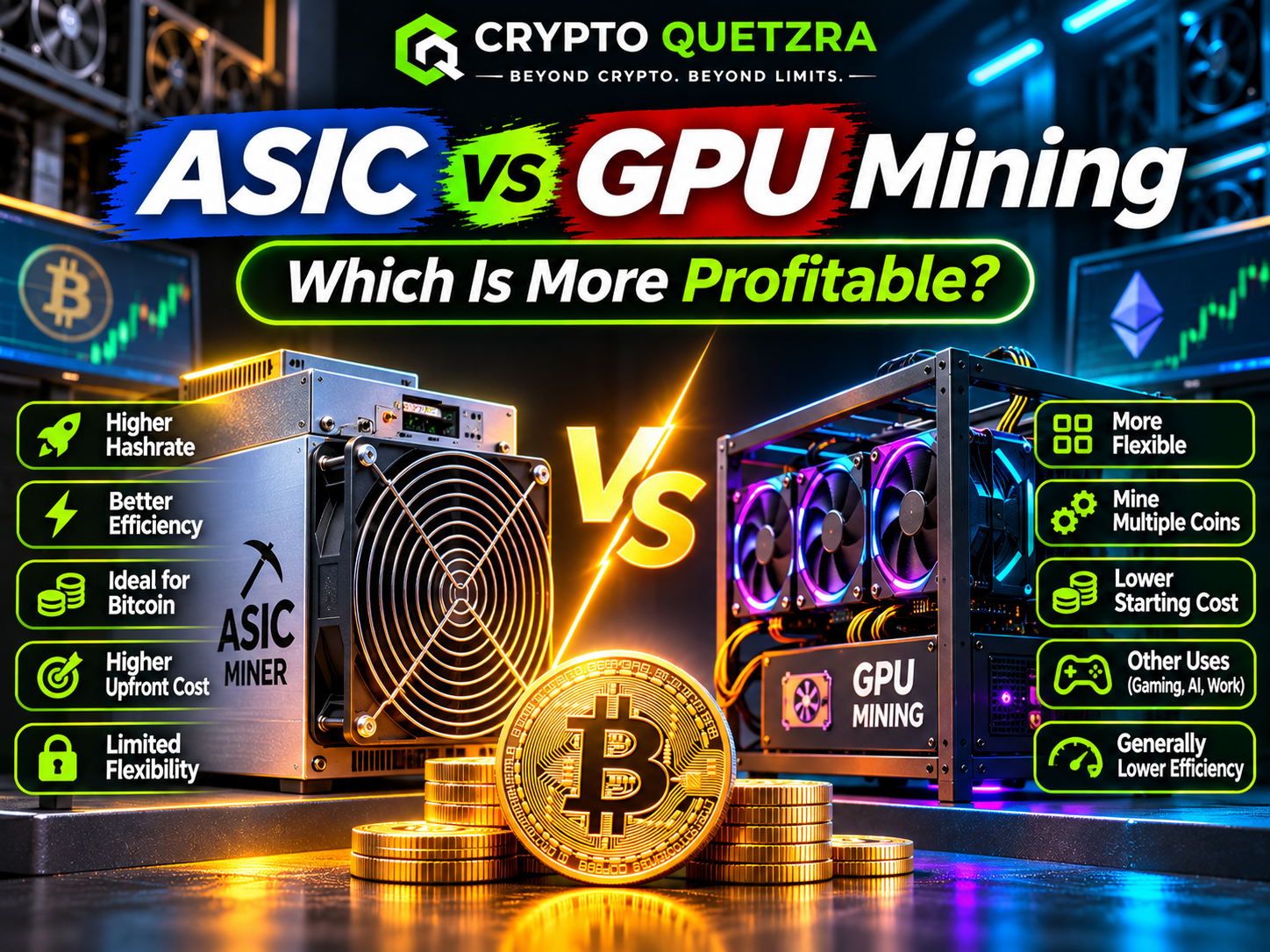
Cryptocurrency mining has become a competitive business where choosing the right hardware can make a major difference to your earnings. ASIC miners are designed to deliver powerful performance for specific mining algorithms, while GPUs offer flexibility across different cryptocurrencies and computing tasks. But which option gives you better returns in 2026? Let’s compare their costs, electricity consumption, performance, hardware requirements, and long-term profitability.
If you have ever considered starting a cryptocurrency mining operation, you have probably come across two types of mining hardware: ASIC machines and GPU graphics cards.
Both can contribute computing power to Proof of Work blockchain networks, but they work in very different ways.
An ASIC miner is built for a specific computational task. It can deliver enormous performance for its supported mining algorithm, often with excellent energy efficiency.
A GPU, on the other hand, is a more flexible piece of hardware. It can process different mining algorithms and can also be used for gaming, video production, artificial intelligence, and other computing workloads.
This creates an interesting question for anyone planning to enter cryptocurrency mining.
Should you invest in a powerful ASIC machine that focuses on one algorithm, or build a GPU mining rig that gives you more flexibility?
The answer depends on your electricity costs, available investment, preferred cryptocurrency, equipment efficiency, and long-term plans.
Let’s examine both options to understand which one makes more financial sense.
1. What Is ASIC Mining?
ASIC stands for Application-Specific Integrated Circuit.
It is a specialized computing chip designed to perform a particular type of operation extremely efficiently.
In cryptocurrency mining, ASIC machines are manufactured to solve the computational problems associated with specific mining algorithms.
Unlike general-purpose computers, they are not designed to handle a wide range of unrelated tasks.
Their main purpose is to deliver maximum mining performance while using as little electricity as practical for the supported algorithm.
How Does ASIC Mining Work?
Consider Bitcoin mining as an example.
Bitcoin uses the SHA-256 hashing algorithm as part of its Proof of Work system.
ASIC manufacturers develop machines specifically for performing SHA-256 calculations at extremely high speeds.
These machines repeatedly calculate hashes as part of the mining process.
When a miner successfully finds a valid block, it can receive the block subsidy and applicable transaction fees.
Because Bitcoin mining has become highly competitive, specialized ASIC hardware is significantly more practical than ordinary graphics cards for this particular activity.
Popular ASIC Mining Manufacturers
Several manufacturers produce cryptocurrency mining equipment.
Bitmain
Bitmain is well known for its Antminer product family, which includes machines designed for different mining algorithms.
MicroBT
MicroBT manufactures WhatsMiner equipment used in cryptocurrency mining operations.
Canaan
Canaan produces Avalon mining hardware and provides equipment for dedicated mining operations.
When selecting an ASIC miner, compare its hashrate, power consumption, efficiency, cooling requirements, warranty, and purchase price.
Do not choose a machine simply because its advertised hashrate is higher than another model.
Electricity efficiency is often just as important.
2. What Is GPU Mining?
GPU stands for Graphics Processing Unit.
A GPU is a computer component originally designed to process graphics, but its parallel processing capabilities also make it useful for several computational tasks.
Certain Proof of Work mining algorithms can be executed efficiently using graphics cards.
Unlike an ASIC miner, a GPU can support different workloads and mining algorithms, depending on the card’s architecture, memory, and available software.
This flexibility is one of the main reasons individual cryptocurrency enthusiasts continue to consider GPU mining.
How Does GPU Mining Work?
A GPU contains numerous processing units capable of handling many calculations simultaneously.
Mining software uses these processing capabilities to perform the mathematical operations required by a compatible Proof of Work algorithm.
Depending on the coin and mining software, the GPU may participate in a mining pool or attempt to mine independently.
For example, Ethereum Classic uses the Etchash algorithm, which supports both GPU and ASIC mining.
Other GPU-oriented mining ecosystems include projects that use different memory-intensive or computational algorithms.
However, not every cryptocurrency can be mined using a GPU.
The cryptocurrency must use a compatible Proof of Work system, and the GPU must meet that network’s hardware requirements.
Popular GPU Manufacturers
Two companies dominate the consumer graphics card market.
NVIDIA
NVIDIA GeForce graphics cards are used for gaming, professional workloads, and compatible cryptocurrency mining algorithms.
AMD
AMD Radeon graphics cards also support various mining workloads and are widely available in the GPU market.
When selecting a card, pay attention to memory capacity, memory bandwidth, power consumption, cooling, driver support, and the specific algorithm you plan to mine.
A powerful gaming GPU is not automatically a profitable mining GPU.
3. ASIC vs GPU Mining: Main Differences
Although both technologies can contribute to cryptocurrency mining, their advantages are quite different.
Here is a practical comparison.
| Feature | ASIC Mining | GPU Mining |
|---|---|---|
| Hardware type | Specialized mining machine | General-purpose graphics card |
| Main purpose | Specific mining algorithms | Multiple computing workloads |
| Hashrate | Usually much higher for supported algorithm | Generally lower for ASIC-dominated algorithms |
| Energy efficiency | Usually superior for its target algorithm | Generally lower on ASIC-dominated algorithms |
| Flexibility | Limited | High |
| Initial investment | Can be substantial | Can start with one GPU |
| Electricity usage | Often high per machine | Depends on number and model of GPUs |
| Cooling | Often requires dedicated ventilation | Standard PC or mining-rig cooling |
| Noise | Frequently high | Usually moderate, depending on setup |
| Maintenance | Specialized components | Familiar PC hardware |
| Resale opportunities | Primarily mining-related | Gaming, workstation, and computing markets |
| Best use | Dedicated algorithm mining | Flexible mining and other GPU workloads |
There is no universal winner.
An ASIC generally dominates when the target algorithm has a mature ASIC mining market.
A GPU may be a better fit when flexibility, incremental investment, and alternative hardware uses matter more than maximum mining efficiency.
4. Which Hardware Produces More Mining Power?
Mining performance is measured differently depending on the algorithm.
For example:
- Bitcoin mining commonly uses terahashes per second (TH/s).
- Some GPU-mined algorithms use megahashes per second (MH/s).
- Other algorithms use kilohashes or different computational measurements.
These measurements should not be compared directly across unrelated algorithms.
An ASIC may produce an enormous number of hashes for its supported algorithm, but that does not automatically mean it can mine every cryptocurrency.
Likewise, a GPU producing a lower numerical hashrate is not necessarily performing poorly. The algorithm itself determines how those numbers should be interpreted.
Why ASIC Miners Usually Have Higher Efficiency
ASIC manufacturers design the hardware around a particular computational workload.
They remove much of the general-purpose functionality needed by ordinary processors and graphics cards.
This allows specialized chips to focus on the calculations that matter for their mining algorithm.
GPUs need to retain broader computing capabilities, which creates a different balance between flexibility and efficiency.
For a coin whose mining algorithm is dominated by ASIC equipment, a GPU will usually struggle to compete on electricity cost per unit of mining work.
However, this does not mean ASIC hardware is always the better financial investment.
The purchase price, electricity contract, expected useful life, and market conditions can change the final result.
5. Which Is More Profitable in 2026: ASIC or GPU Mining?
Now we come to the most important question.
Profitability is not determined by hashrate alone.
A machine can generate substantial mining rewards and still lose money after operating costs are included.
The two most important calculations are mining revenue and total operating expenses.
ASIC Mining Profitability
ASIC miners are generally more attractive for dedicated cryptocurrency mining when their target algorithm is suitable for specialized hardware.
For example, Bitcoin mining is dominated by SHA-256 ASIC machines.
A modern Bitcoin ASIC can deliver enormous computing power compared with a conventional GPU.
However, Bitcoin mining profitability depends on several variables:
- ASIC purchase price.
- Electricity cost per kilowatt-hour.
- Machine efficiency.
- Bitcoin price.
- Network difficulty.
- Mining pool fees.
- Hardware uptime.
- Cooling and maintenance expenses.
A machine that appears profitable today may become less attractive if mining difficulty increases or Bitcoin’s price declines.
GPU Mining Profitability
GPU mining follows a different economic model.
A graphics card can mine different compatible cryptocurrencies, depending on their algorithms and network conditions.
If one coin becomes less profitable, the owner may be able to switch to another compatible mining algorithm.
This flexibility can be useful, but it does not guarantee higher earnings.
GPU miners also face competition from other graphics cards and dedicated ASIC machines where those devices are supported.
Other costs include:
- GPU purchase price.
- Electricity.
- Motherboard and processor.
- RAM and storage.
- Power supply.
- Cooling fans.
- Maintenance.
- Mining pool fees.
A multi-GPU rig also needs sufficient electrical infrastructure and adequate airflow.
Which One Has the Better Profit Potential?
For Bitcoin specifically, ASIC mining is overwhelmingly the more practical approach.
For GPU-compatible Proof of Work cryptocurrencies, the answer depends on the algorithm and whether ASIC competition exists.
If your objective is maximum mining efficiency for a mature ASIC-dominated algorithm, an ASIC will generally have the advantage.
If your objective is flexibility and the ability to use hardware for other purposes, a GPU rig may be more attractive.
6. Understanding Electricity Costs: ASIC vs GPU
Electricity is one of the biggest expenses in cryptocurrency mining.
Even efficient equipment can become unprofitable when power prices are too high.
Let’s look at two hypothetical examples.
Example A: A GPU Mining Rig
Imagine a GPU rig that consumes 1,200 watts in total.
Convert the power consumption into kilowatts:
1,200 ÷ 1,000 = 1.2 kW.
Assuming the machine operates continuously:
1.2 × 24 = 28.8 kWh per day.
Over 30 days:
28.8 × 30 = 864 kWh.
At an electricity rate of $0.10 per kWh:
864 × $0.10 = $86.40 monthly.
Example B: An ASIC Mining Machine
Now consider a hypothetical ASIC miner consuming 3,500 watts.
Convert the power consumption:
3,500 ÷ 1,000 = 3.5 kW.
Daily electricity consumption:
3.5 × 24 = 84 kWh.
Monthly consumption:
84 × 30 = 2,520 kWh.
At $0.10 per kWh:
2,520 × $0.10 = $252 monthly.
Electricity Cost Comparison
| Measurement | GPU Rig | ASIC Miner |
|---|---|---|
| Power consumption | 1,200 W | 3,500 W |
| Daily consumption | 28.8 kWh | 84 kWh |
| Monthly consumption | 864 kWh | 2,520 kWh |
| Monthly cost at $0.10/kWh | $86.40 | $252 |
These are illustrative electricity calculations, not a performance or profitability comparison.
The two machines do not produce equivalent hashrates, and they may mine different algorithms.
Actual power consumption also depends on hardware settings, cooling, and other system components.
The important lesson is that you should calculate your own electricity costs before buying any mining equipment.
7. Which Cryptocurrency Can You Mine With ASICs and GPUs?
One of the biggest differences between the two options is algorithm compatibility.
ASIC machines are built for particular algorithms, while GPUs can support a wider range of computational workloads.
Here are some examples.
Bitcoin (BTC)
Bitcoin uses SHA-256.
Modern competitive Bitcoin mining requires specialized ASIC equipment.
GPU mining is not a realistic approach for generating competitive Bitcoin mining revenue.
Litecoin (LTC) and Dogecoin (DOGE)
Litecoin uses the Scrypt Proof of Work algorithm.
Specialized Scrypt ASICs are commonly used for Litecoin and Dogecoin mining.
The two networks support merged mining, which allows compatible miners to participate in both networks using the same Scrypt work.
Ethereum Classic (ETC)
Ethereum Classic uses the Etchash Proof of Work algorithm.
It supports both GPU and specialized ASIC mining.
This makes it a useful example when comparing the two hardware types.
GPU owners can participate using compatible software, while ASIC owners can benefit from hardware specifically designed for Etchash.
Ergo (ERG)
Ergo uses the Autolykos Proof of Work algorithm.
Its original design aimed to make mining more accessible and ASIC-resistant.
However, developers and miners should not assume that an ASIC-resistant design guarantees that specialized hardware will never become available.
The algorithm, network conditions, and hardware ecosystem can evolve over time.
Important Ethereum Mining Note
Ethereum Mainnet no longer supports mining.
The network moved from Proof of Work to Proof of Stake in September 2022.
ETH is now secured through validators that participate in staking.
Ethereum Classic (ETC) is a separate blockchain and continues to use Proof of Work.
This distinction is important because many outdated mining guides still incorrectly suggest that you can mine ETH with a GPU.
8. Hardware Costs: Which Is Cheaper to Start With?
Your initial investment can influence how quickly a mining operation becomes financially viable.
GPU mining generally allows more gradual entry.
You can begin with one graphics card and expand your setup over time.
ASIC mining often requires a larger upfront commitment, particularly when purchasing modern industrial-grade equipment.
However, prices vary considerably by model, manufacturer, condition, and availability.
GPU Mining Investment
A GPU setup may require:
- One or more graphics cards.
- A compatible motherboard.
- A processor.
- RAM and storage.
- Power supply units.
- Cooling equipment.
- A mining frame.
- Electrical accessories.
One advantage is that some components can be reused for gaming, workstation computing, or other workloads.
ASIC Mining Investment
An ASIC setup may require:
- A compatible ASIC miner.
- Suitable electrical circuits.
- Proper power distribution.
- Dedicated ventilation.
- Networking equipment.
- Cooling infrastructure.
- Maintenance and replacement parts.
Some specialized ASICs also require industrial-style power and cooling arrangements.
Before purchasing an ASIC, check whether your location can safely support its continuous power demand.
Which Is More Budget-Friendly?
For someone starting with a small budget, GPU mining usually offers more flexibility because you can build gradually.
For an operator with access to suitable infrastructure and inexpensive electricity, ASIC equipment may offer better mining efficiency.
The purchase price alone does not determine which investment is better.
9. Noise and Cooling: An Important Difference for Home Miners
Mining machines operate under sustained workloads and generate considerable heat.
However, the noise and cooling requirements vary between ASICs and GPUs.
ASIC Noise and Temperature
Many industrial ASIC miners use high-speed fans to move large amounts of air through their hardware.
This can produce significant noise.
Some high-performance models are unsuitable for an ordinary bedroom or living space.
Depending on the equipment, operators may need dedicated ventilation, sound isolation, or liquid-cooling infrastructure.
GPU Mining Noise and Temperature
GPU rigs generally use cooling systems designed for computer workloads.
The noise level depends on the number of cards, fan speeds, case design, room temperature, and power limits.
A well-designed GPU setup can be more manageable in a home environment, although a large multi-GPU rig can still generate substantial heat and noise.
For residential miners, operating conditions should be considered before buying either type of equipment.
10. Can You Earn More With GPU Mining by Switching Coins?
One of the main attractions of GPU mining is the ability to change mining algorithms when market conditions shift.
Suppose you own a GPU mining rig that supports multiple compatible algorithms.
If the estimated revenue from one cryptocurrency falls, you can investigate another compatible Proof of Work network.
This provides more flexibility than owning an ASIC designed for one specific algorithm.
However, switching coins does not automatically create higher profits.
Before changing networks, consider:
- Current mining difficulty.
- Coin market price.
- Expected rewards.
- Exchange liquidity.
- Mining pool fees.
- Hardware power consumption.
- Network stability.
- Selling costs.
A coin can show an attractive mining reward while having limited exchange liquidity.
In that situation, converting the earned tokens into cash may be difficult or costly.
GPU flexibility is valuable, but it should be supported by careful research.
11. Can You Use Mining Hardware for Other Purposes?
This is another important difference when evaluating the long-term value of your equipment.
GPU Hardware Has Multiple Uses
A graphics card can be used for:
- Gaming.
- Video editing.
- 3D rendering.
- Machine learning workloads.
- AI development.
- Scientific computing.
- Cryptocurrency mining.
This creates alternative uses if mining becomes unprofitable.
A GPU can potentially be sold to another customer interested in gaming or computing.
However, resale value depends on the card’s age, physical condition, market demand, and new hardware releases.
Mining wear can also reduce resale appeal.
ASIC Hardware Has More Limited Uses
An ASIC miner is generally designed for a particular mining algorithm.
A SHA-256 miner cannot simply be switched to mine an unrelated algorithm such as Scrypt.
Some ASIC hardware may support multiple coins using the same underlying algorithm, but its usefulness remains specialized.
If mining economics deteriorate or the network changes its algorithm, the machine may lose much of its practical value.
This is an important consideration when calculating long-term equipment depreciation.
12. What Is the Best Choice for Beginners?
Your choice should depend on what you actually want to achieve.
Choose ASIC Mining If:
- You want to focus on a specific Proof of Work algorithm.
- You have access to reliable and inexpensive electricity.
- You can manage substantial power consumption.
- You understand mining difficulty and hardware depreciation.
- You have suitable cooling and ventilation.
- You are comfortable with a specialized machine that has limited alternative uses.
Choose GPU Mining If:
- You want to begin with a smaller setup.
- You prefer the ability to switch compatible mining algorithms.
- You already own suitable graphics cards.
- You want equipment with additional computing uses.
- You prefer expanding your setup gradually.
- You understand that GPU mining returns can be highly variable.
For a beginner who already owns a compatible gaming computer, testing a GPU-minable cryptocurrency may be a reasonable educational starting point.
For someone specifically interested in Bitcoin mining, a GPU is not a practical substitute for an ASIC.
13. How to Calculate Mining Profit Before Buying Hardware
Never purchase a mining machine based entirely on an online advertisement or a social media video showing daily earnings.
Use a mining profitability calculator and enter the actual specifications of the equipment you plan to purchase.
You should know:
Hardware hashrate: The computing power of the miner for the selected algorithm.
Power consumption: The actual electrical demand in watts.
Electricity price: Your complete cost per kilowatt-hour.
Mining difficulty: The current level of competition on the network.
Coin price: The current market value of the cryptocurrency.
Mining pool fee: The percentage deducted from rewards.
Operating expenses: Cooling, repairs, infrastructure, and other costs.
The Mining Profit Formula
Net Mining Profit = Mining Revenue − Electricity Cost − Pool Fees − Cooling − Maintenance − Other Operating Costs.
For a proper investment calculation, also account for equipment purchase price, depreciation, financing costs, and potential resale value.
Calculate Your Electricity Expense
Use this simple formula:
Daily Electricity Cost = Power Consumption (kW) × 24 × Electricity Price.
For example, a 2 kW machine running continuously at $0.10 per kWh costs:
2 × 24 × $0.10 = $4.80 per day.
That equals $144 over a 30-day month.
This calculation tells you the electricity expense, not the amount of money the miner will earn.
Your actual profit depends on mining revenue and all other operating costs.
14. Common Mistakes When Choosing Between ASIC and GPU Mining
Before investing in mining hardware, avoid these common mistakes.
Buying hardware without calculating electricity costs
A machine can generate impressive mining revenue but still operate at a loss.
Comparing hashrate numbers from different algorithms
A terahash on SHA-256 cannot be directly compared with a megahash on Etchash.
Ignoring network difficulty
As more computing power joins a network, mining competition changes. Revenue estimates must account for that.
Assuming current mining returns will continue
Cryptocurrency prices, network rewards, and difficulty can change significantly.
Purchasing outdated equipment
Older miners may consume too much electricity relative to their computational output.
Forgetting cooling and electrical installation
The advertised machine price rarely represents the complete cost of running a mining operation.
Treating GPU flexibility as guaranteed profit
Being able to switch coins does not mean every alternative cryptocurrency will be profitable.
Ignoring resale and depreciation
Mining hardware loses value as newer models arrive or its target algorithm becomes less attractive.
Final Verdict: ASIC vs GPU Mining — Which Is More Profitable?
ASIC and GPU mining offer different advantages, and the better investment depends on your mining strategy.
ASIC miners generally provide better performance and electricity efficiency for algorithms they are specifically designed to support.
That makes them the practical choice for dedicated Bitcoin mining and many other ASIC-dominated mining networks.
GPU mining offers greater flexibility.
You can switch between compatible algorithms, start with a smaller setup, and potentially use the graphics cards for gaming, rendering, and other computing tasks.
However, that flexibility does not guarantee higher returns.
For someone focused on mining Bitcoin, ASIC hardware is the clear choice.
For someone interested in experimenting with different GPU-compatible cryptocurrencies while maintaining alternative uses for the hardware, GPU mining may be more suitable.
The real winner is the hardware that produces the best net return after electricity, equipment costs, maintenance, and depreciation are included.
Before spending money, calculate your operating expenses, research the target cryptocurrency, and compare realistic mining revenue.
A profitable mining operation starts with understanding the numbers, not simply buying the most powerful machine.
Frequently Asked Questions (FAQs)
1. Is ASIC mining more profitable than GPU mining?
ASIC mining is generally more efficient for algorithms designed around specialized hardware. However, profitability depends on electricity costs, mining competition, equipment prices, and cryptocurrency market conditions.
2. Can GPUs mine Bitcoin in 2026?
GPUs can technically perform SHA-256 calculations, but they are not economically competitive with modern Bitcoin ASIC miners. ASIC hardware is the practical choice for Bitcoin mining.
3. Is GPU mining still profitable in 2026?
GPU mining can be profitable under suitable conditions, but results depend on the cryptocurrency, mining algorithm, hardware efficiency, electricity price, and network difficulty. Always calculate the complete operating costs.
4. Can ASIC miners mine different cryptocurrencies?
Yes, but only when those cryptocurrencies use an algorithm supported by the ASIC. For example, compatible SHA-256 ASICs can mine Bitcoin and other SHA-256-based cryptocurrencies.
5. Which is cheaper to start: ASIC or GPU mining?
GPU mining generally offers more flexible entry options because you can start with one card and expand gradually. ASIC prices vary widely, and some industrial models also require expensive electrical and cooling infrastructure.
6. Can I use my GPU after mining becomes unprofitable?
Yes. You can potentially use a graphics card for gaming, rendering, video editing, and supported AI or computing workloads. Its condition and resale value depend on usage and market demand.
7. Does ASIC mining consume more electricity than GPU mining?
A single industrial ASIC can consume more electricity than an individual graphics card. However, power consumption alone does not establish profitability. You must compare energy use with the mining work produced on the same algorithm.
8. Can Ethereum still be mined using GPUs?
No. Ethereum Mainnet stopped Proof of Work mining in September 2022 and now uses Proof of Stake. Ethereum Classic is a separate Proof of Work blockchain that supports GPU and ASIC mining.
9. What matters more: hashrate or electricity efficiency?
Both matter, but electricity efficiency is especially important when evaluating profitability. A miner with a higher hashrate may still produce weaker financial results if it consumes substantially more power or costs significantly more to purchase.
10. Should beginners invest in ASIC or GPU mining?
Beginners should first understand electricity costs, network difficulty, hardware requirements, and mining revenue. A GPU may offer more flexibility for learning, while an ASIC is more suitable for someone committed to a specific mining algorithm.
Disclaimer
This article is for educational and informational purposes only. It does not constitute financial, investment, or technical advice. Cryptocurrency mining involves financial risks, hardware depreciation, electricity expenses, and changing network conditions. Mining revenue is not guaranteed, and equipment may lose value. Always check local regulations, electrical safety requirements, and current mining profitability before investing.
Crypto Quetzra — Beyond Crypto. Beyond Limits.
Official Sources and Further Reading
- Ethereum — Mining Is No Longer Possible on Ethereum Mainnet: https://ethereum.org/developers/docs/consensus-mechanisms/pow/mining/
- Ethereum Classic — Miner FAQs: https://www.ethereumclassic.org/faqs/miners/
- Ethereum Classic — Mining Hardware Guide: https://www.ethereumclassic.org/mining/hardware/
- NVIDIA — GeForce RTX 5090 Specifications: https://www.nvidia.com/en-us/geforce/graphics-cards/50-series/rtx-5090/
- Ergo — Autolykos Mining Documentation: https://docs.ergoplatform.com/mining/autolykos/
- ASIC Miner Value — Mining Hardware and Profitability Comparisons: https://www.asicminervalue.com/
- Bitcoin — Official Developer Documentation: https://developer.bitcoin.org/