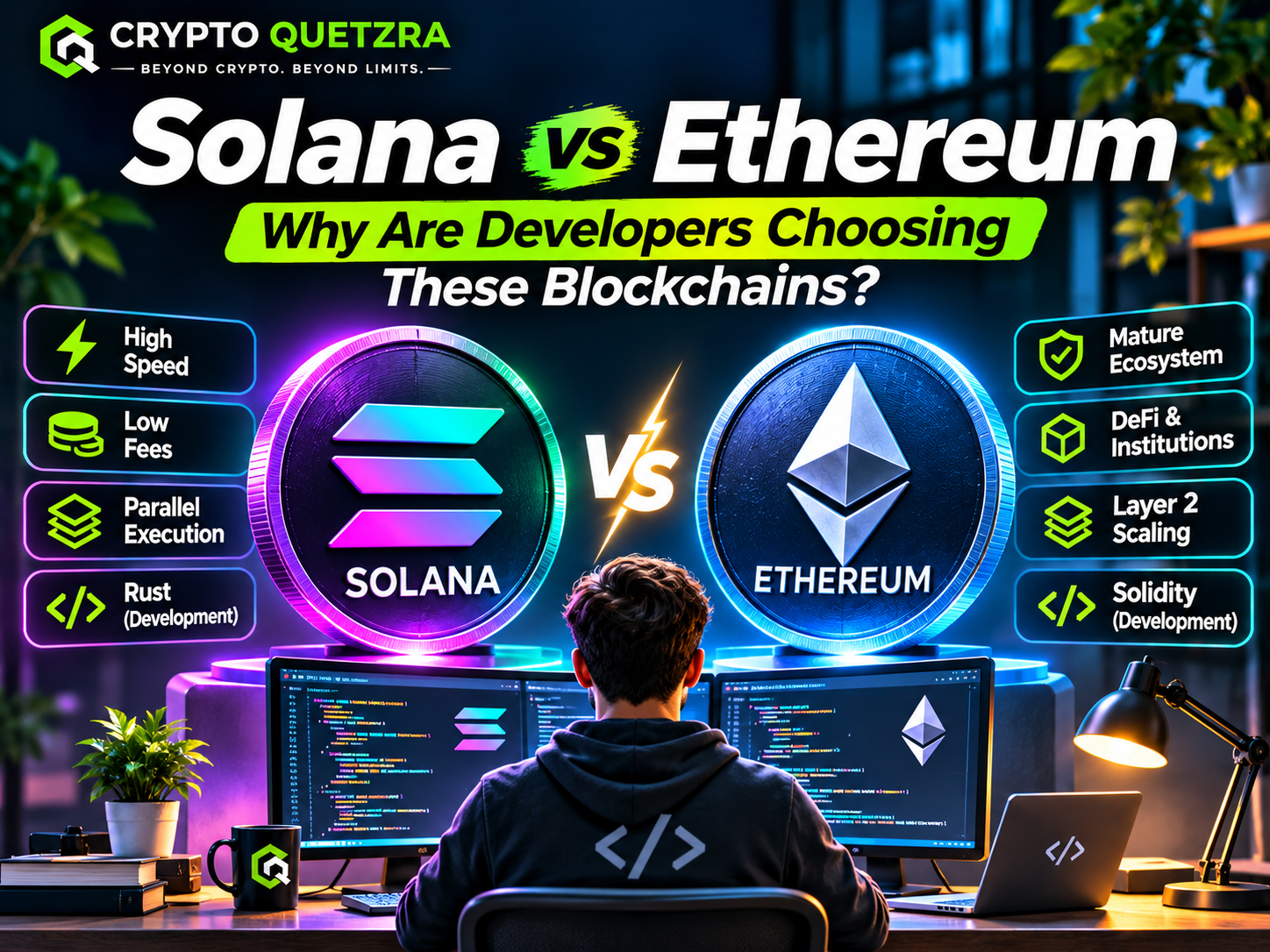
Solana and Ethereum have become two major destinations for blockchain developers, but they offer very different approaches to building decentralized applications. Ethereum has a mature smart contract ecosystem and a large developer community, while Solana attracts builders looking for fast transactions, low fees, and a different programming architecture. So why are developers choosing one network over the other, and which blockchain offers better opportunities for building the next generation of Web3 applications?
Building a blockchain application involves much more than writing code and connecting a cryptocurrency wallet.
Developers need a network that can handle transactions, support smart contracts, provide reliable infrastructure, and allow applications to grow without creating unnecessary costs for users.
This is where the competition between Solana and Ethereum becomes interesting.
Both networks support decentralized applications, digital assets, financial products, and blockchain-based services. However, they approach the technical challenges differently.
Ethereum has spent years developing an extensive ecosystem around the Ethereum Virtual Machine (EVM), Solidity programming, decentralized finance, and a growing collection of Layer 2 networks.
Solana takes another approach. Its architecture is designed to process many transactions efficiently through parallel execution, while its development environment relies heavily on Rust and Solana-specific tools.
For developers, this is not simply a competition between two cryptocurrency tokens. It is a decision about which technical environment is better suited to the product they want to build.
Let’s explore the differences and understand why both ecosystems continue to attract developers in 2026.
1. What Is Ethereum and Why Do Developers Use It?
Ethereum is a programmable blockchain that allows developers to create smart contracts and decentralized applications.
It launched in 2015 and introduced a flexible environment where software programs could operate directly on a public blockchain.
Unlike a traditional application that depends entirely on centralized servers, an Ethereum decentralized application can use smart contracts to manage transactions, assets, permissions, and other important operations.
For example, a developer can create a lending application in which users deposit digital assets, borrow against collateral, and interact with predefined financial rules without relying on a conventional bank to manage every transaction.
Ethereum supports a wide range of applications, including:
- Decentralized finance platforms.
- NFT marketplaces.
- Stablecoin payment systems.
- Decentralized exchanges.
- Blockchain gaming applications.
- Tokenization platforms.
- Digital identity and authentication systems.
- Onchain financial infrastructure.
Why Is Ethereum Attractive to Developers?
One of Ethereum’s biggest advantages is its established development ecosystem.
Developers can use Solidity, a programming language specifically designed for writing smart contracts that execute on the Ethereum Virtual Machine.
The ecosystem also provides extensive development resources, testing frameworks, libraries, documentation, security tools, and community support.
Popular development tools include:
Hardhat: A development environment used to compile, test, deploy, and debug smart contracts.
Foundry: A development toolkit that supports contract testing, deployment, and debugging.
OpenZeppelin: A collection of commonly used smart contract libraries and security-related development resources.
Viem and Ethers.js: JavaScript and TypeScript libraries used to interact with Ethereum applications and smart contracts.
These tools make it easier for development teams to build applications without creating every component from scratch.
Another advantage is that Ethereum’s ecosystem extends beyond its main blockchain through Layer 2 networks.
This gives developers access to multiple environments that maintain compatibility with the Ethereum development stack while offering different performance and cost characteristics.
For teams developing financial applications or complex smart contract systems, this established infrastructure can be extremely valuable.
2. What Is Solana and Why Are Developers Interested in It?
Solana is a high-performance blockchain designed to support fast transaction processing and scalable decentralized applications.
Its architecture focuses on handling large amounts of transaction activity while maintaining relatively low transaction costs.
Instead of following Ethereum’s exact execution model, Solana uses a different system built around accounts, programs, instructions, and parallel transaction processing.
Developers can use this architecture to create applications where users interact with blockchain systems frequently.
Solana supports applications involving:
- Decentralized exchanges.
- Trading platforms.
- Digital payment systems.
- NFT marketplaces.
- Blockchain games.
- Token launch platforms.
- DeFi applications.
- Consumer-focused Web3 products.
What Makes Solana Attractive to Developers?
Solana’s biggest attraction is the combination of transaction performance and its application development environment.
The network is designed to execute compatible transactions in parallel when their account requirements do not conflict.
This allows it to make use of multiple processing cores rather than treating every independent transaction as part of one strictly sequential execution flow.
Another important feature is its account-based architecture.
Solana programs are generally stateless, meaning the application’s mutable data is stored in separate accounts and provided to programs when instructions are executed.
This differs from Ethereum, where smart contracts generally contain both execution logic and associated contract storage.
Solana developers primarily use Rust to write onchain programs.
They can also use frameworks such as Anchor to reduce development boilerplate, define account validation rules, and generate interface descriptions for clients.
These characteristics make Solana particularly interesting for teams building applications that need frequent interactions and relatively inexpensive transactions.
Official documentation: https://solana.com/docs/core
3. Solana vs Ethereum: Main Technical Differences
Before deciding which network is better for development, it is important to understand their architectural differences.
| Feature | Ethereum | Solana |
|---|---|---|
| Launch year | 2015 | 2020 |
| Native token | ETH | SOL |
| Consensus | Proof of Stake | Proof of Stake-based consensus with Proof of History |
| Main smart contract language | Solidity | Rust |
| Execution environment | Ethereum Virtual Machine (EVM) | Solana Virtual Machine (SVM) |
| Data model | Account-based | Account-based with separate program state |
| Transaction processing | Primarily sequential on Ethereum L1 | Parallel execution where accounts do not conflict |
| Transaction fees | Gas paid in ETH | Base and optional priority fees paid in SOL |
| Scaling approach | Layer 2 rollups and protocol improvements | High-throughput Layer 1 architecture |
| Development frameworks | Hardhat, Foundry, OpenZeppelin | Anchor, Pinocchio and native Rust tools |
| Major ecosystem strength | DeFi infrastructure and EVM compatibility | High-throughput applications and low-cost interactions |
Both networks have their own design priorities.
Ethereum places significant emphasis on decentralization, security, and a broad ecosystem of compatible applications.
Solana focuses on integrating high transaction throughput into its Layer 1 architecture.
Neither approach is universally better. The right choice depends on the application’s technical requirements.
4. Why Are Developers Choosing Solana?
Solana has attracted developers who want to build applications where transaction speed, affordability, and frequent user interaction are important.
Here are some of the main reasons.
A. Fast Transaction Processing
Imagine using a decentralized trading application where every purchase, sale, or interaction requires a blockchain transaction.
Users may become frustrated when transactions take too long or become expensive during periods of heavy network activity.
Solana is designed to handle a large number of transactions through parallel execution.
Its architecture allows independent transactions to be processed concurrently when their account access requirements permit it.
For developers, this creates opportunities to design applications around more frequent blockchain interactions.
Examples include:
- Onchain trading applications.
- High-frequency consumer interactions.
- Blockchain gaming.
- Digital payment products.
- Real-time financial applications.
However, theoretical transaction capacity should not be confused with real-world application performance.
Developers should examine actual network conditions, confirmation behavior, transaction success rates, and infrastructure reliability before choosing a chain.
B. Relatively Low Transaction Costs
Transaction fees are another major reason developers consider Solana.
On Solana, transaction fees consist of a base fee and an optional prioritization fee.
The base fee compensates validators for transaction signature verification, while the priority fee can help a transaction compete for processing priority.
Because many consumer applications involve repeated transactions, keeping these costs manageable can improve the user experience.
Consider a gaming application where users need to make frequent small transactions.
A fee structure that makes every interaction expensive can discourage users from participating.
Solana’s fee model can make certain applications more practical.
However, low fees are not guaranteed under every network condition. Priority fees can increase when competition for block space rises.
Official documentation: https://solana.com/docs/core/fees
C. Parallel Transaction Execution
This is one of Solana’s most important technical differences.
On many traditional computing systems, multiple tasks can run simultaneously when they do not depend on one another.
Solana applies a related idea to transaction execution.
Transactions specify which accounts they need to read or modify. This information helps the network identify which transactions can run in parallel and which must wait because they access conflicting state.
For example, two users interacting with separate accounts may be able to execute their transactions concurrently.
However, transactions attempting to modify the same account may create dependencies that limit parallel execution.
This design is useful for applications with large volumes of independent activity.
D. Rust-Based Development
Solana primarily uses Rust for writing onchain programs.
Rust is known for its memory safety features and strong type system.
For developers already experienced with Rust, Solana can provide a familiar programming environment.
The Anchor framework further simplifies development by offering tools for account validation, program interfaces, and testing.
There is a learning curve, especially for teams accustomed to Solidity and EVM development.
Nevertheless, developers who want to build performance-oriented blockchain software may find this environment attractive.
E. Consumer-Friendly Applications
Solana’s performance and transaction-cost design make it interesting for applications intended for everyday users.
Examples include payment applications, digital marketplaces, games, and trading products.
When users interact with an application frequently, even small transaction costs and delays can influence their experience.
For developers, this means they can design products around more regular onchain activity without relying entirely on offchain workarounds.
However, user experience also depends on wallet design, application security, network reliability, and the complexity of the product.
Low fees alone do not make a successful application.
5. Why Are Developers Still Choosing Ethereum?
Although Solana has attracted considerable developer interest, Ethereum remains one of the most established smart contract ecosystems.
Its advantages are not limited to its main blockchain.
They also include the broader network of EVM-compatible tools, Layer 2 systems, applications, and developer communities.
A. A Mature Smart Contract Ecosystem
Ethereum has an extensive collection of existing smart contracts, development frameworks, libraries, protocols, and technical documentation.
Developers can reuse established components instead of rebuilding standard functionality.
For example, a team creating a decentralized financial application may use audited token standards, access-control libraries, and established smart contract development tools.
This can reduce development time when used correctly.
However, reusing existing contracts does not remove the need for security audits and independent testing.
B. Solidity Is Widely Used
Solidity is the main smart contract programming language associated with Ethereum.
It was developed specifically for the EVM and uses familiar programming concepts found in languages such as JavaScript and C++.
Developers can use Solidity to build:
- Token contracts.
- Decentralized exchanges.
- Lending protocols.
- NFT systems.
- Multisignature wallets.
- Governance applications.
- Automated financial products.
One advantage is the availability of experienced developers and established learning resources.
A company building an Ethereum-based application may find it easier to recruit developers who already understand Solidity, although availability varies by location and project requirements.
C. Access to the EVM Ecosystem
The Ethereum Virtual Machine is not limited to Ethereum Mainnet.
Many other blockchain networks support EVM-compatible execution environments.
This gives developers a broader deployment strategy.
They may be able to reuse Solidity contracts and familiar development tools across different compatible networks, although some applications still require adjustments for specific network features.
For example, a project can deploy versions of its decentralized application on Ethereum and compatible Layer 2 networks.
This provides more choices when balancing transaction costs, liquidity, and security requirements.
D. Ethereum Layer 2 Networks
One common criticism of Ethereum has been the cost and capacity limitations of its main network during periods of high demand.
Layer 2 networks address this challenge by processing transactions separately and using Ethereum as part of their security and settlement architecture.
Examples include:
- Arbitrum.
- Optimism.
- Base.
- zkSync.
Many rollups bundle multiple transactions and submit relevant data or proofs to Ethereum.
This allows users to access lower-cost transactions while benefiting from different levels of integration with Ethereum Mainnet.
For developers, Layer 2 networks create opportunities to build applications without relying exclusively on Ethereum Mainnet for every user interaction.
However, each Layer 2 has its own technical architecture, security assumptions, sequencer design, and withdrawal conditions.
Developers should evaluate these differences rather than assuming that every Ethereum-related network offers identical security.
Official documentation: https://ethereum.org/developers/docs/scaling/
E. Established DeFi Infrastructure
Ethereum has a long history of decentralized finance development.
Its ecosystem contains lending protocols, decentralized exchanges, stablecoin systems, asset-management applications, and infrastructure for other financial products.
Developers can connect their applications to existing protocols rather than designing an entire financial ecosystem from the beginning.
This composability is useful.
For example, a new financial application may integrate with existing stablecoins, decentralized exchanges, or lending infrastructure.
That can make product development easier, provided the underlying protocols are suitable and secure.
6. Developer Activity in 2026: Which Ecosystem Is Growing?
Developer activity offers another perspective on the competition between Solana and Ethereum.
It is useful because it measures something different from cryptocurrency prices, market capitalization, or social media popularity.
One current reference is the Electric Capital Developer Report.
Its November 2, 2026 data provides a snapshot of monthly active developer activity across cryptocurrency ecosystems.
For the individual ecosystems, the report lists:
| Developer Metric | Ethereum | Solana |
|---|---|---|
| Full-time developers | 2,615 | 676 |
| Total monthly active developers | 8,779 | 2,678 |
| Full-time developer growth over one year | 45.4% | 54.8% |
| Established developers | 4,367 | 1,300 |
The figures show two different strengths.
Ethereum has a larger overall developer community in this dataset.
Solana, however, shows a higher one-year growth rate among full-time contributors in the same snapshot.
This suggests that Solana is attracting additional development capacity while Ethereum maintains a substantial established ecosystem.
There is an important limitation: developer counts are not a direct measure of software quality, application success, security, or future adoption. Electric Capital counts original code authors using its own activity and tenure definitions.
You can explore the data directly here:
https://www.developerreport.com/
The practical conclusion is that both ecosystems have meaningful developer communities. A smaller ecosystem can grow quickly without immediately becoming larger than an established one.
7. Which Blockchain Is Better for Building DeFi Applications?
Decentralized finance is one of the most competitive areas of blockchain development.
Both Ethereum and Solana support decentralized exchanges, lending protocols, stablecoins, liquidity pools, and other financial applications.
However, their technical strengths can influence how developers approach product design.
Ethereum for DeFi
Ethereum offers an established environment for building complex financial smart contracts.
Its extensive library ecosystem and EVM compatibility make it attractive for projects that need integrations with existing protocols and other EVM networks.
Developers can build applications that interact with established decentralized exchanges, lending markets, and token systems.
Layer 2 networks also provide additional deployment options.
Solana for DeFi
Solana offers an environment suited to applications that benefit from frequent, relatively low-cost transactions.
Its parallel execution architecture and account model can support trading applications and other products with significant transaction activity.
Developers may find it attractive for applications where quick interactions and affordable transaction execution are important.
Which One Should a DeFi Developer Choose?
The decision depends on the intended product.
A complex financial protocol requiring extensive existing EVM integrations may fit Ethereum’s broader ecosystem.
A trading product that depends on frequent low-cost interactions may find Solana’s architecture attractive.
Neither network removes the need for smart contract audits, economic testing, or careful liquidity management.
8. Which Blockchain Is Better for Gaming and Consumer Applications?
Blockchain games and consumer applications face different challenges from traditional financial protocols.
A gaming application may require frequent user actions, digital item transfers, rewards, and interaction with application state.
A consumer payment application may need to process many small transactions without making every action expensive.
Solana’s transaction model can be attractive for these applications because developers can design around relatively low transaction costs and high transaction throughput.
Ethereum also supports gaming and consumer applications, particularly through its Layer 2 ecosystem.
These networks can offer different balances of application compatibility, liquidity, and security.
The right decision depends on the actual user experience.
For example, a game that needs frequent low-cost onchain interactions may prefer a different infrastructure choice from a marketplace focused on high-value assets and established EVM integrations.
Developers should choose technology based on user requirements instead of assuming that one blockchain is suitable for every product.
9. Solana vs Ethereum: What Are the Biggest Disadvantages?
A useful comparison must examine the weaknesses of both ecosystems, not just their advantages.
Solana’s Challenges
Different development model
Solana’s account and program architecture can require developers coming from Ethereum to learn new concepts.
Understanding accounts, program-derived addresses, cross-program invocations, and account validation is essential.
Rust learning curve
Developers without Rust experience may need additional time to become comfortable with the programming environment.
Validator hardware and infrastructure
High-performance blockchain infrastructure can create challenges around operating costs and validator requirements.
The network’s performance goals need to be balanced with decentralization and accessibility.
Application and protocol security
Solana programs can contain serious software vulnerabilities, just like smart contracts on other networks.
Developers must carefully manage account permissions, program logic, and external dependencies.
Ethereum’s Challenges
Mainnet execution costs
Ethereum Mainnet uses gas fees to measure and charge for computational resources.
Complex transactions can require more gas, and competition for block space can increase costs.
Layer 2 networks help address this issue, but they introduce their own differences and risks.
Fragmentation across networks
Ethereum’s scaling ecosystem includes multiple Layer 2 networks.
Moving assets and applications between them can introduce additional user-experience, liquidity, and interoperability challenges.
Smart contract complexity
Solidity makes powerful applications possible, but complex smart contracts can be difficult to secure.
Coding mistakes, logic errors, and economic vulnerabilities can cause significant financial losses.
Infrastructure and tooling decisions
Ethereum developers have access to many tools, but choosing the correct combination of frameworks, libraries, networks, and development services still requires technical judgment.
Neither ecosystem offers a perfect development environment.
10. Can Developers Build on Both Solana and Ethereum?
Yes. Developers do not necessarily need to choose only one blockchain.
A project can use both ecosystems when doing so provides a clear technical or business advantage.
This approach is sometimes described as multichain development.
For example, a company might:
- Deploy a core financial application on Ethereum.
- Offer a faster or lower-cost user experience through a suitable Layer 2.
- Support certain consumer-facing features on Solana.
- Use cross-chain infrastructure to connect assets or application functionality.
However, multichain development is not automatically better.
Each additional network can introduce new engineering work, deployment requirements, security assumptions, liquidity considerations, monitoring needs, and maintenance costs.
Cross-chain bridges and messaging systems also create additional attack surfaces.
A smaller product team may be better served by focusing on one ecosystem until its application has a clear reason to expand.
11. How Should a Developer Choose Between Solana and Ethereum?
Instead of following market popularity, developers should evaluate their actual project requirements.
Here are some practical questions to consider.
What programming language does your team know?
Teams experienced in Solidity may find Ethereum and other EVM-compatible networks easier to enter.
Teams with strong Rust experience may be more comfortable developing Solana programs.
How frequently will users interact with the blockchain?
Applications requiring many low-cost interactions may benefit from Solana’s architecture or a suitable Ethereum Layer 2.
Does your application depend on existing protocols?
If your product needs extensive integrations with established EVM financial infrastructure, Ethereum may offer a more convenient starting point.
What type of security model do you need?
Examine validator infrastructure, network security, smart contract execution, asset custody, and the operational requirements of each environment.
Where are your users?
Consider wallet availability, liquidity, network costs, supported exchanges, and the experience of onboarding new users.
Can your team maintain the application?
A chain that is technically impressive but difficult for your team to support may create long-term development problems.
The best blockchain is the one that allows your team to build and maintain a reliable product for its intended users.
Final Verdict: Solana vs Ethereum — Which Blockchain Is Better for Developers?
Solana and Ethereum are competing for developer attention, but they represent different approaches to building blockchain applications.
Ethereum offers a mature ecosystem, widespread Solidity development, established financial infrastructure, and an expanding network of Layer 2 solutions.
Solana offers a different development experience built around Rust, parallel transaction processing, and relatively low transaction fees.
For developers building complex financial protocols, products that require broad EVM compatibility, or applications that benefit from established DeFi infrastructure, Ethereum can be a strong choice.
For developers creating trading applications, consumer products, payment systems, or software that benefits from frequent low-cost interactions, Solana may offer attractive advantages.
The developer activity data also shows that Ethereum currently has a larger developer community, while Solana has been growing quickly among full-time contributors.
The real winner is not necessarily the blockchain with the highest transaction count or the largest developer community. It is the network that gives developers the right tools, security assumptions, performance characteristics, and ecosystem support for the application they want to build.
Rather than expecting one blockchain to replace the other, it may be more useful to view them as two important parts of a growing multichain industry.
Frequently Asked Questions (FAQs)
1. Is Solana better than Ethereum for developers?
Not in every situation. Solana can be attractive for applications requiring high throughput and frequent low-cost interactions. Ethereum offers a mature development ecosystem, extensive EVM compatibility, and established DeFi infrastructure.
2. Which programming language is used for Solana development?
Rust is the primary language used for Solana onchain programs. Developers also use frameworks such as Anchor to simplify program development and account validation.
3. What programming language is used for Ethereum smart contracts?
Solidity is the most widely associated smart contract language for Ethereum. It is designed to compile into bytecode executed by the Ethereum Virtual Machine.
4. Why are Solana transactions generally inexpensive?
Solana uses a transaction fee model with a base fee and an optional prioritization fee. Its architecture is designed for high transaction throughput, helping support low-cost interactions under normal network conditions. Fees can still change during periods of congestion.
5. Does Ethereum support fast and low-cost transactions?
Yes. Ethereum’s Layer 2 networks process transactions separately and use Ethereum as part of their security and settlement architecture. Many provide lower transaction costs than Ethereum Mainnet.
6. Which blockchain has more developers in 2026?
In Electric Capital’s November 2, 2026 snapshot, Ethereum had 8,779 total monthly active developers compared with 2,678 for Solana. Solana’s full-time developer cohort showed higher one-year growth in that dataset.
7. Is Solana built using Rust?
Yes. Solana programs are primarily written in Rust and compiled into Solana’s bytecode format for execution by its runtime.
8. Can Ethereum developers switch to Solana?
Yes. Ethereum developers can learn Solana development, but they must understand its account model, program architecture, Rust environment, and development tools.
9. Which blockchain is better for decentralized finance?
Ethereum has a mature DeFi ecosystem and broad EVM integration. Solana provides an attractive environment for applications that require frequent transactions and relatively low fees. The best choice depends on the product’s design, liquidity needs, and security requirements.
10. Can an application use both Solana and Ethereum?
Yes. Multichain applications can operate across both ecosystems. However, they require additional engineering, interoperability planning, security reviews, and ongoing maintenance.
Disclaimer
This article is for educational and informational purposes only. It does not constitute financial, investment, or technical advice. Blockchain ecosystems evolve continuously, and their performance, fees, security, and developer activity can change. Always verify technical information and evaluate project risks before making investment or development decisions.
Crypto Quetzra — Beyond Crypto. Beyond Limits.
Official Sources and Further Reading
- Ethereum Developer Documentation: https://ethereum.org/developers/docs/
- Solana Core Concepts: https://solana.com/docs/core
- Solana Program Execution: https://solana.com/docs/core/programs/program-execution
- Solana Transaction Fees: https://solana.com/docs/core/fees
- Solana’s Guide for Ethereum Developers: https://solana.com/developers/migrate-to-solana/complete-guide
- Ethereum Scaling Documentation: https://ethereum.org/developers/docs/scaling/
- Electric Capital Developer Report: https://www.developerreport.com/
- Solidity Documentation: https://docs.solidity.org/