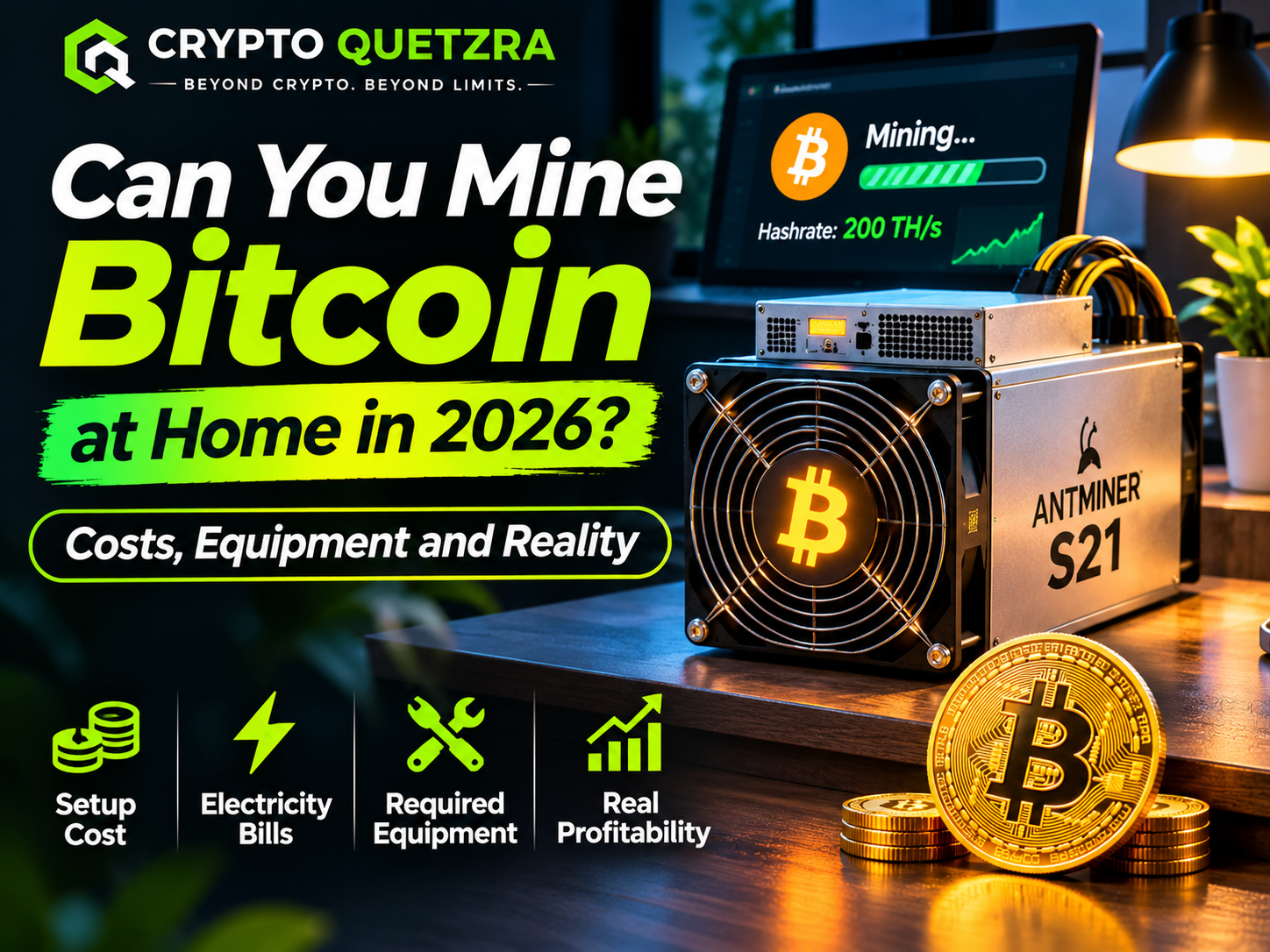
Bitcoin mining is no longer the simple computer activity it was in its early days. Today, earning Bitcoin through mining requires specialized hardware, considerable electricity, proper cooling, and careful financial planning. But can an ordinary person still mine Bitcoin from home in 2026? Let’s explore the equipment, costs, electricity requirements, and real profitability behind home Bitcoin mining.
Bitcoin mining has changed dramatically over the years.
When Bitcoin first appeared, enthusiasts could experiment with mining using ordinary computer processors. As more people joined the network, competition increased, and specialized mining equipment gradually replaced standard computers.
Today, Bitcoin mining is a highly competitive industry. Large operations run thousands of machines, negotiate electricity contracts, and invest heavily in cooling systems and infrastructure.
That does not mean individuals are completely excluded.
You can still operate a Bitcoin miner from your home, but whether doing so makes financial sense is a different question.
A machine might successfully contribute computing power to the Bitcoin network while still costing more to operate than the value of the Bitcoin it earns.
In this guide, we will look beyond the excitement surrounding cryptocurrency mining and examine what a realistic home mining setup involves in 2026.
1. What Is Bitcoin Mining and How Does It Work?
Bitcoin mining is the process through which specialized computers compete to add new transaction blocks to the Bitcoin blockchain.
These machines perform calculations using a cryptographic process called Proof of Work.
Miners repeatedly calculate hashes until one finds a result that meets the network’s current difficulty requirements.
The successful miner gets the opportunity to add a valid block and receive the associated block subsidy and transaction fees.
Other participants verify the block, helping maintain the integrity of the network.
How Do Bitcoin Miners Make Money?
Bitcoin miners receive two main sources of revenue:
Block subsidy: Newly issued Bitcoin awarded to the successful miner when a valid block is added.
Transaction fees: Fees paid by users whose transactions are included in that block.
Since the April 2024 Bitcoin halving, the block subsidy has been 3.125 BTC per block. Transaction fees are additional and vary depending on network activity.
However, finding a block is extremely competitive. An individual home miner with limited computing power has a very small chance of finding a block independently.
That is why most smaller miners participate in mining pools.
2. Can You Mine Bitcoin at Home in 2026?
Yes, you can mine Bitcoin at home in 2026, but the equipment and operating costs make it challenging.
The most important thing to understand is that modern Bitcoin mining requires specialized hardware called an ASIC.
ASIC stands for Application-Specific Integrated Circuit. Unlike an ordinary computer, an ASIC miner is designed specifically to perform the calculations required by Bitcoin’s SHA-256 mining algorithm.
A gaming computer, laptop, or standard desktop cannot compete economically with modern Bitcoin mining machines.
Home mining is generally more realistic when you have:
- Access to inexpensive and reliable electricity.
- A modern, energy-efficient ASIC miner.
- A suitable electrical installation.
- Enough space for ventilation and cooling.
- A location where continuous machine noise will not cause problems.
- A realistic budget for equipment, maintenance, and repairs.
If your electricity is expensive and you are planning to run a large ASIC miner inside a normal bedroom, the economics and practical conditions may quickly become difficult.
3. What Equipment Do You Need to Mine Bitcoin at Home?
You do not need an industrial mining facility to start experimenting with Bitcoin mining, but you do need equipment that matches your intended operation.
Here are the main components.
A. ASIC Bitcoin Miner
<IMAGE_PLACEHOLDER>
The ASIC miner is the most important part of your setup.
Some established manufacturers include Bitmain, MicroBT, and Canaan.
Examples of Bitcoin mining equipment include:
Antminer S21
The Bitmain Antminer S21 is a SHA-256 ASIC miner rated at approximately:
- Hashrate: 200 TH/s.
- Power consumption: 3,500 watts.
- Energy efficiency: 17.5 J/TH.
Antminer S21 Pro
The S21 Pro offers another example of modern mining hardware:
- Hashrate: 234 TH/s.
- Power consumption: 3,510 watts.
- Energy efficiency: 15 J/TH.
- Manufacturer-rated noise: approximately 76 dBA.
These specifications illustrate why choosing equipment based on efficiency matters.
A machine with higher hashrate is not necessarily the best purchase if it consumes significantly more electricity.
When comparing miners, examine their joules per terahash (J/TH). A lower figure means the machine uses less energy to perform the same amount of hashing work.
Always check the manufacturer’s official specifications and the exact model before purchasing.
B. Reliable Power Supply
An ASIC miner requires a suitable power supply and electrical connection.
A machine drawing approximately 3,500 watts needs a properly rated electrical circuit capable of supporting continuous operation.
Before installation, have a qualified electrician check:
- Available electrical capacity.
- Circuit breaker rating.
- Wiring condition.
- Grounding and electrical protection.
- Power supply compatibility.
- Continuous-load requirements.
Do not connect a high-powered mining machine to an unsuitable household extension cable or overloaded electrical circuit.
C. Cooling and Ventilation
Mining hardware generates substantial heat.
A miner operating continuously needs a reliable flow of fresh air to prevent overheating.
Depending on the machine and environment, you may need:
- Dedicated ventilation.
- Exhaust fans.
- Air intake filters.
- Suitable room temperature.
- Dust management.
- Temperature monitoring.
A poorly ventilated room can cause thermal problems, reduced performance, and premature hardware wear.
D. Internet Connection
Bitcoin mining does not require an exceptionally fast internet connection.
What matters more is a reliable connection with minimal interruptions.
Your mining machine needs to communicate consistently with its mining pool or the Bitcoin network.
A stable wired Ethernet connection is generally preferable to relying on an inconsistent wireless connection.
E. Bitcoin Wallet
You also need a Bitcoin wallet to receive mining rewards.
A wallet provides a Bitcoin receiving address, allowing your mining pool to send your payouts.
For long-term storage, consider learning about hardware wallets and secure backup procedures.
Never share your wallet’s recovery phrase with anyone.
4. How Much Electricity Does a Bitcoin Miner Consume?
Electricity is usually one of the largest ongoing costs of Bitcoin mining.
To understand the financial impact, let’s use a real manufacturer-rated example.
The Antminer S21 consumes approximately 3,500 watts, equivalent to 3.5 kilowatts.
If it operates continuously for 24 hours:
3.5 kW × 24 hours = 84 kWh per day.
Over 30 days:
84 kWh × 30 = 2,520 kWh per month.
That is a substantial amount of electricity for a household.
Monthly Electricity Cost Example
The following table shows what the electricity bill could look like at different electricity rates.
| Electricity Rate | Daily Cost | Monthly Cost |
|---|---|---|
| $0.03/kWh | $2.52 | $75.60 |
| $0.05/kWh | $4.20 | $126.00 |
| $0.08/kWh | $6.72 | $201.60 |
| $0.10/kWh | $8.40 | $252.00 |
| $0.15/kWh | $12.60 | $378.00 |
| $0.20/kWh | $16.80 | $504.00 |
These figures cover electricity consumed by the miner only. They do not include additional ventilation, cooling, networking, hardware costs, repairs, or other expenses.
Actual consumption may also differ from the manufacturer’s rated figure.
The important lesson is simple: a small difference in your electricity price can make a significant difference to your mining expenses.
5. How Much Does It Cost to Start Bitcoin Mining at Home?
The cost of starting a home mining operation depends on the equipment you purchase and the condition of your existing electrical infrastructure.
A complete setup may require:
- An ASIC mining machine.
- Electrical installation.
- Ventilation equipment.
- Internet connectivity.
- A Bitcoin wallet.
- Mining pool configuration.
- Maintenance and replacement parts.
There is no single reliable equipment price because ASIC prices change according to availability, model generation, market demand, shipping costs, and local import duties.
Example Home Mining Budget
Consider the following illustrative planning budget:
| Item | Example Budget |
|---|---|
| ASIC miner | $2,000 |
| Electrical installation | $250 |
| Ventilation setup | $200 |
| Networking and accessories | $50 |
| Initial maintenance reserve | $100 |
| Total | $2,600 |
These are example budgeting assumptions, not verified November 2026 market quotations.
An actual purchase could cost considerably more or less.
Before purchasing equipment, compare the final delivered price from reputable suppliers. Include shipping, customs duties, taxes, warranty coverage, and potential repair expenses.
Buying a cheap second-hand miner without testing it can turn an apparently attractive investment into an expensive repair project.
6. How Does a Bitcoin Mining Pool Work?
Imagine trying to win a competition against thousands of other participants using only one computer.
Your chances of finding a block independently would be extremely small.
A mining pool addresses this problem by allowing multiple miners to combine their computing power.
When the pool successfully mines a block, its reward and transaction fees are distributed among participating miners according to the pool’s payout rules.
You do not receive the entire block reward simply because your machine participates.
Instead, you receive a share of the pool’s earnings based on your contributed work and the payout method.
Why Do Home Miners Join Pools?
Mining pools provide several advantages:
- More consistent payout opportunities.
- No need to independently find a complete Bitcoin block.
- Easier performance monitoring.
- Transparent contribution tracking on reputable platforms.
- Convenient reward distribution.
However, mining pools charge fees, and payout methods differ.
Before joining a pool, investigate its reputation, fee structure, minimum payout, payment method, and withdrawal policies.
Avoid unknown platforms promising guaranteed daily Bitcoin profits.
7. Is Bitcoin Mining Profitable at Home in 2026?
This is the question most people want answered.
The honest answer is that home Bitcoin mining can be profitable under the right conditions, but residential electricity prices and hardware costs make it difficult for many individuals.
Mining profitability depends on several changing factors:
Bitcoin price: A higher BTC price can increase the dollar value of mining rewards, while a lower price can reduce revenue.
Network difficulty: As more computing power competes to mine Bitcoin, an individual miner generally earns a smaller share of expected rewards.
Electricity price: Your power bill directly affects operating expenses.
Hardware efficiency: More efficient machines can generate more computing power for each unit of electricity.
Mining pool fees: A portion of mining revenue may be deducted by the pool.
Equipment uptime: Hardware failures, maintenance, and network interruptions reduce the time your machine earns rewards.
Hardware depreciation: Older equipment can become less competitive as newer and more efficient machines enter the market.
The Most Important Profitability Calculation
Before buying a miner, calculate your expected daily revenue and compare it with the daily operating costs.
A simplified formula is:
Daily Mining Profit = Daily Mining Revenue − Electricity Cost − Pool Fees − Other Operating Costs.
However, this does not include the original equipment purchase price.
For a complete investment analysis, you must also account for hardware depreciation, installation expenses, repairs, and the time required to recover your initial investment.
A miner that covers its electricity bill is not necessarily a profitable investment.
8. How to Calculate Your Bitcoin Mining Electricity Costs
Let’s use the Antminer S21 as an example.
Its rated power consumption is approximately 3,500 watts.
First, convert watts into kilowatts:
3,500 ÷ 1,000 = 3.5 kW.
Now multiply by the number of operating hours:
3.5 × 24 = 84 kWh per day.
If your electricity rate is $0.10 per kWh:
84 × $0.10 = $8.40 daily electricity cost.
For a 30-day month:
$8.40 × 30 = $252.
This calculation tells you exactly how much electricity the miner consumes under the stated assumptions.
However, it does not tell you how much Bitcoin the machine will earn.
To estimate mining revenue, you also need current network hashrate, network difficulty, block rewards, transaction fees, pool fees, and your machine’s actual hashrate.
Because these variables change, use a current mining profitability calculator before making a purchase.
Never rely on a calculator screenshot from several months ago.
9. Why Mining at Home Is Difficult for Ordinary People
Bitcoin mining is technically accessible, but running it economically is a different challenge.
Several practical issues can make home mining unsuitable.
High Electricity Bills
A powerful ASIC miner can consume more electricity than many household appliances combined.
If your electricity rate is high, operating expenses may exceed mining revenue.
Extreme Noise
ASIC miners are designed for performance rather than quiet operation.
The Antminer S21 Pro has a manufacturer-rated noise level of approximately 76 dBA.
That can be extremely disruptive in a bedroom, apartment, or shared living space.
Excessive Heat
A miner consuming 3,500 watts converts nearly all of that electrical energy into heat.
That heat must go somewhere.
During warmer months, managing the temperature can become especially challenging.
Hardware Maintenance
Mining equipment operates for long periods under demanding conditions.
Fans, power supplies, connectors, and other components can eventually require maintenance or replacement.
Competition From Large Mining Operations
Large mining companies can benefit from bulk equipment purchases, specialized facilities, industrial cooling, and negotiated electricity contracts.
An individual homeowner may struggle to match their operating costs.
10. Can You Mine Bitcoin Using a Gaming PC or Laptop?
You may find websites and videos claiming that you can mine Bitcoin using a normal laptop or gaming computer.
Technically, a computer can perform SHA-256 calculations, but that does not mean it can compete economically with dedicated ASIC miners.
Modern Bitcoin mining is dominated by specialized hardware.
A typical laptop or gaming PC has a negligible share of the network’s total Bitcoin mining power.
Running mining software on ordinary hardware can consume electricity, generate heat, and reduce equipment lifespan without producing meaningful Bitcoin rewards.
If your goal is to mine Bitcoin competitively, a dedicated ASIC is the relevant hardware category.
If your goal is simply to learn how mining works, experimenting with mining simulations or small educational devices is a more sensible approach.
11. Is Solo Bitcoin Mining Better Than Pool Mining?
There are two main ways an individual can participate in Bitcoin mining.
Solo Mining
In solo mining, you attempt to find valid Bitcoin blocks independently.
If you successfully find a block, you receive the associated block subsidy and transaction fees.
The problem is probability.
A small home miner has a tiny proportion of the network’s overall computing power. It could operate for a very long time without finding a block.
Solo mining is therefore generally unsuitable for anyone expecting regular income from a small machine.
Pool Mining
In pool mining, you combine your hashrate with other miners.
When the pool earns mining rewards, you receive a share according to its payout system.
Pool mining is generally more practical for smaller operators who want more predictable payouts.
However, payouts are not guaranteed, and your actual earnings still depend on the machine’s performance and changing network conditions.
12. Is Bitcoin Mining Legal in Your Country?
Before installing a mining machine, check the rules in your location.
Cryptocurrency regulations vary considerably between countries.
Some jurisdictions permit mining under specific conditions, while others impose restrictions involving electricity use, business registration, taxation, imports, or cryptocurrency-related activities.
You should investigate:
- Whether cryptocurrency mining is legally permitted.
- Whether residential electricity can be used for commercial computing equipment.
- Whether special electricity tariffs or permissions apply.
- Whether imported ASIC equipment requires customs documentation.
- Whether mining revenue must be declared for tax purposes.
- Whether your electrical installation meets local safety regulations.
Do not assume that purchasing an ASIC automatically gives you permission to operate it anywhere.
Local utility rules and electricity agreements matter just as much as the technical setup.
13. Is Home Bitcoin Mining Worth It Compared With Buying Bitcoin?
This is an important comparison for anyone considering spending thousands of dollars on mining equipment.
Suppose you have a budget of $2,600.
You could use that money to purchase Bitcoin through a suitable exchange, or you could purchase an ASIC miner and use it to generate mining rewards over time.
Both approaches involve cryptocurrency market risk, but their cost structures are different.
Buying Bitcoin Directly
Advantages:
- No mining electricity bill.
- No ASIC maintenance.
- No ventilation requirements.
- No mining pool fees.
- Easier to manage for beginners.
Risks:
- Bitcoin’s market price can decline.
- Exchange and custody risks.
- You do not generate mining rewards.
Mining Bitcoin
Advantages:
- Participate directly in Bitcoin’s Proof of Work system.
- Receive a share of mining rewards through a pool.
- Learn about mining hardware and blockchain infrastructure.
- Potentially generate Bitcoin over time.
Risks:
- High electricity expenses.
- ASIC purchase and depreciation.
- Noise and heat.
- Maintenance and equipment failures.
- Uncertain future mining revenue.
- Competition and network difficulty.
The better approach depends on your electricity rate, equipment efficiency, purchase price, and personal goals.
For someone with expensive residential electricity, buying Bitcoin directly may be financially simpler than operating a mining machine.
For someone with genuinely inexpensive power and suitable infrastructure, mining may deserve further investigation.
Neither option guarantees a positive return.
14. A Practical Checklist Before Starting Home Mining
Before purchasing your first ASIC miner, work through this checklist.
-
Check the legality of mining in your location.
-
Obtain your actual electricity rate, including applicable taxes and additional charges.
-
Compare modern ASIC miners by J/TH efficiency.
-
Verify the machine’s power requirements.
-
Calculate daily and monthly electricity consumption.
-
Check the machine’s noise rating.
-
Plan a safe ventilation system.
-
Confirm your electrical installation is suitable.
-
Research mining pool fees and payout policies.
-
Calculate expected revenue using current network data.
-
Include equipment depreciation and maintenance.
-
Check the supplier’s warranty and reputation.
-
Keep a separate reserve for repairs and unexpected expenses.
If the numbers do not make sense before purchasing the equipment, they are unlikely to improve simply because the machine has been switched on.
Final Verdict: Should You Mine Bitcoin at Home in 2026?
Yes, home Bitcoin mining is still possible in 2026. However, the days when an ordinary computer could compete meaningfully for Bitcoin rewards are long gone.
Modern mining requires specialized ASIC hardware, reliable electricity, effective ventilation, and careful cost management.
The biggest factor is not how much computing power your machine advertises. It is how efficiently that machine converts electricity into mining work and whether the resulting revenue covers your total expenses.
If you have inexpensive electricity, suitable infrastructure, and access to efficient equipment, home mining may be worth investigating.
But if you are paying high residential electricity rates, have limited ventilation, or expect quick returns from a single ASIC, the financial reality may be disappointing.
The smartest mining decision starts with a calculator, not a shopping cart.
Before investing in mining equipment, compare the cost of operating an ASIC with the alternative of purchasing Bitcoin directly. Understanding the numbers can save you from an expensive mistake.
Frequently Asked Questions (FAQs)
1. Can I mine Bitcoin at home in 2026?
Yes. You can mine Bitcoin at home using specialized ASIC hardware, but profitability depends on electricity prices, machine efficiency, network difficulty, Bitcoin’s market price, and other expenses.
2. How much electricity does a Bitcoin mining machine use?
It depends on the model. For example, a 3,500-watt ASIC operating continuously consumes approximately 84 kWh per day or 2,520 kWh over 30 days.
3. Can I mine Bitcoin with a normal computer?
A normal computer can perform SHA-256 calculations, but it cannot compete economically with specialized ASIC miners on the Bitcoin network.
4. What is the best equipment for Bitcoin mining at home?
There is no universally best miner. Compare hashrate, electricity consumption, J/TH efficiency, purchase price, noise, warranty, and operating requirements before selecting a machine.
5. How much money can a home Bitcoin miner make per month?
There is no fixed monthly income. Mining revenue changes with Bitcoin’s price, network difficulty, transaction fees, pool fees, and your machine’s performance. Always calculate electricity and other costs before estimating profit.
6. Is Bitcoin mining profitable with free electricity?
Free or extremely inexpensive electricity can improve mining economics, but it does not guarantee profit. Equipment costs, hardware depreciation, maintenance, downtime, and network competition still matter.
7. Is solo mining better than joining a mining pool?
For most small home miners, a reputable mining pool offers more frequent and predictable payouts than solo mining. Solo mining involves a much smaller chance of finding a block.
8. Does Bitcoin mining damage a computer?
ASIC miners are separate specialized machines, but they operate under substantial electrical and thermal loads. Poor ventilation, excessive temperatures, and unsuitable electrical connections can damage equipment or create safety hazards.
9. How much space do I need for a Bitcoin miner?
The physical machine may be relatively compact, but you also need sufficient space for airflow, heat removal, electrical equipment, and maintenance access. Noise and ventilation often matter more than the machine’s physical dimensions.
10. Will Bitcoin mining become more difficult in the future?
Mining difficulty adjusts as network participation changes. If more computing power joins the network, difficulty generally increases. Future mining economics depend on network competition, hardware efficiency, Bitcoin prices, and the reward structure.
Disclaimer
This article is provided for educational and informational purposes only. It is not financial, investment, tax, electrical, or legal advice. Cryptocurrency mining involves financial, technical, and operational risks. Mining revenue is not guaranteed, and equipment may lose value. Always verify local regulations, electricity costs, hardware specifications, and current network conditions before investing.
Crypto Quetzra — Beyond Crypto. Beyond Limits.