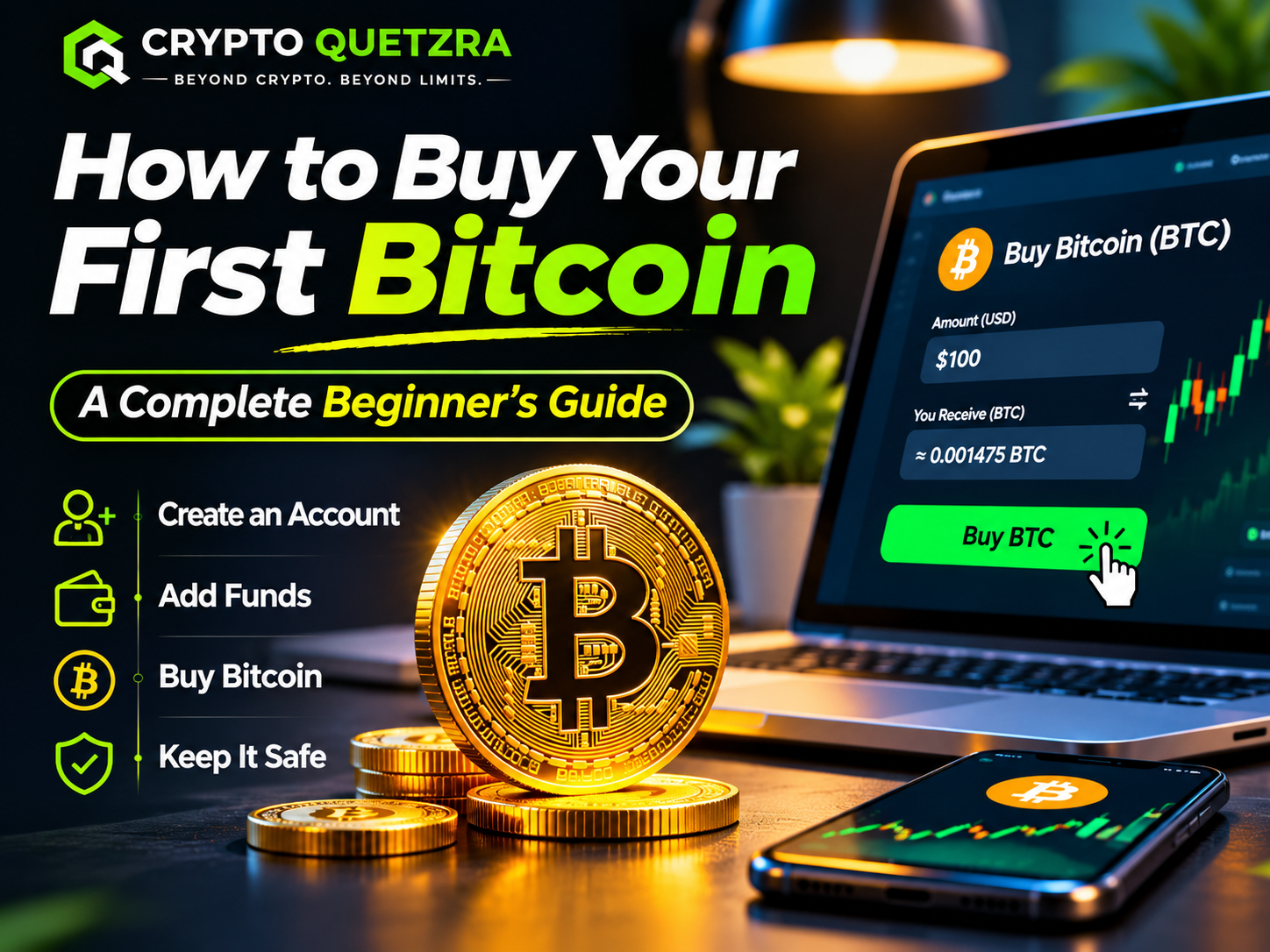
Buying Bitcoin for the first time can feel confusing. Which platform should you use? How much money do you need? Where does your Bitcoin go after you purchase it? This beginner-friendly guide explains the entire process, including account setup, payment methods, transaction fees, wallet security, and mistakes you should avoid.
Imagine opening a cryptocurrency website and seeing Bitcoin trading at thousands of dollars. You might assume that buying it requires a large amount of money or advanced trading knowledge.
That is not how Bitcoin works.
You do not need to purchase one complete Bitcoin. The cryptocurrency can be divided into smaller units, which means you can buy a fraction based on the amount you can afford.
For someone entering the cryptocurrency market, the first purchase is less about making a quick profit and more about understanding how the system works.
However, buying Bitcoin is not the same as purchasing an ordinary product online. Prices can change rapidly, transactions sent to the wrong address may be difficult or impossible to recover, and choosing an unsuitable platform can put your funds at risk.
This guide walks you through the process in simple language so you can understand what you are doing before spending your money.
1. Understand What You Are Buying Before Purchasing Bitcoin
Bitcoin (BTC) is a decentralized digital currency that operates through a network of computers rather than relying on a central bank to process transactions.
People use Bitcoin for different reasons. Some see it as a long-term investment, others use it to transfer value, and some are interested in its underlying technology.
When you purchase Bitcoin, you are buying a digital asset whose market price changes according to supply, demand, investor activity, and broader economic conditions.
There are three important things every first-time buyer should understand.
Bitcoin is divisible.
One Bitcoin can be divided into 100 million smaller units called satoshis. You can purchase a small fraction instead of paying for an entire coin.
Bitcoin does not guarantee profits.
Its price can rise or fall significantly. Buying Bitcoin does not automatically mean your investment will increase in value.
You need a way to access your Bitcoin.
You can hold Bitcoin through a cryptocurrency platform or use a personal wallet. These options have different responsibilities and security considerations.
Understanding these basics will make the purchasing process much easier.
2. Decide How Much Money You Can Afford to Invest
Before creating an exchange account, decide how much money you are comfortable putting into cryptocurrency.
A common beginner mistake is purchasing more Bitcoin than they can financially afford to lose because they expect prices to increase.
Cryptocurrency markets can move quickly in either direction. Even Bitcoin, the largest cryptocurrency by market capitalization, has experienced substantial price declines throughout its history.
Consider these guidelines before making your first purchase:
- Never use rent, food, education, or emergency savings to purchase Bitcoin.
- Avoid borrowing money to invest in cryptocurrency.
- Do not use credit or loans simply because you expect Bitcoin to increase in price.
- Keep your first purchase small enough that a major loss would not affect your everyday financial needs.
- Understand the total purchase and withdrawal fees before completing an order.
You can also consider buying smaller amounts at regular intervals rather than purchasing everything at once. This approach is commonly called dollar-cost averaging.
It can reduce the importance of choosing one particular buying date, but it does not guarantee profits or protect you from market losses.
3. Choose a Reliable Cryptocurrency Exchange
A cryptocurrency exchange is an online platform where users can purchase, sell, or trade digital assets.
For many beginners, an established exchange is the simplest starting point because it provides an interface for creating an account, adding funds, and placing a Bitcoin purchase.
However, not every website that advertises cryptocurrency services is legitimate.
Before choosing a platform, investigate the following features.
What to Check Before Selecting an Exchange
Regulatory status
Check whether the platform is legally permitted to serve customers in your country. Verify its licensing or registration claims directly with the relevant regulator where applicable.
Security features
Look for two-factor authentication, login notifications, withdrawal controls, and a clear account-security policy.
Payment methods
Check whether the exchange supports payment methods available in your country, such as bank transfers or supported debit and credit cards.
Transparent fees
Review deposit charges, trading fees, withdrawal fees, currency-conversion costs, and any difference between the quoted market price and the actual purchase price.
Bitcoin withdrawals
Confirm whether you can withdraw actual Bitcoin to an external wallet. Some products provide only price exposure rather than ownership of transferable BTC.
Customer support
Look for accessible support channels and a clear process for reporting suspicious account activity.
A useful starting point is to compare several platforms rather than immediately signing up with the first exchange appearing in a search result.
Remember that registration or a professional-looking website does not automatically make a company safe. The CFTC advises consumers to research cryptocurrency platforms and understand the risks before transferring money.
4. Create Your Cryptocurrency Exchange Account
After selecting a platform, the next step is creating an account.
Although the exact process varies, most established exchanges follow a similar registration procedure.
Step 1: Visit the Official Website
Open the exchange’s official website or download its verified mobile application.
Be careful with sponsored search results, social media advertisements, and links sent through unexpected messages. Fake websites can imitate the appearance of legitimate cryptocurrency platforms.
Check the domain carefully before entering personal information.
Step 2: Register Your Account
Select the registration option and provide the information requested by the platform.
This commonly includes:
- Your email address.
- A secure password.
- Your country of residence.
- Basic personal information.
Use an email account that you control and protect with strong security.
Step 3: Complete Identity Verification
Many regulated cryptocurrency platforms require customers to verify their identity.
This process is commonly known as Know Your Customer (KYC).
Depending on your location and the platform, you may be asked to provide:
- A government-issued identity document.
- A photograph or selfie.
- Proof of address.
- Additional information required by local regulations.
Submit documents only through the platform’s verified website or official application.
Step 4: Secure Your Account
Do not treat account security as an optional step.
Create a unique password and activate multi-factor authentication.
An authenticator application or passkey may provide stronger protection than relying exclusively on SMS verification, depending on the available options.
Never share login verification codes with another person.
Once your account is verified and protected, you can move to the funding process.
5. Add Money to Your Exchange Account
Before purchasing Bitcoin, you usually need to deposit money into your exchange account or select an available payment method during checkout.
The supported options depend on your country and the exchange.
Common methods include:
Bank transfer: Some platforms allow customers to transfer money directly from a bank account. Processing times and fees vary.
Debit or credit card: Certain exchanges support card payments, although the associated costs can be higher.
Other supported payment methods: Depending on the region, exchanges may offer additional local payment services.
Before making a deposit, check the following:
- Is the payment method available in your country?
- What is the deposit fee?
- How long will the deposit take?
- Are there minimum deposit requirements?
- Does the exchange charge a separate conversion fee?
Do not transfer money to a personal bank account or an unfamiliar recipient simply because someone claims to represent an exchange.
For your first purchase, a payment method provided directly through the official exchange is generally easier to understand and track.
6. How to Purchase Your First Bitcoin
Now comes the main part: purchasing Bitcoin.
Once your account has been funded, locate Bitcoin using its official ticker symbol, BTC.
You will normally see a price displayed in a currency such as USD, EUR, or your supported local currency.
You do not have to purchase one complete Bitcoin.
For example, imagine that you decide to purchase $25 worth of Bitcoin. The exchange calculates how much BTC your money can buy using the current quoted price and applicable fees.
The actual amount you receive depends on the execution price and costs at that moment.
Understanding the Two Common Buying Methods
Instant Buy
This option is designed for convenience.
You enter the amount you want to spend, review the quoted Bitcoin amount, and confirm the purchase.
It is usually straightforward for beginners, but the displayed quote may include a spread or additional service fees.
Market Order
A market order attempts to purchase Bitcoin at the best available prices in the order book.
The final execution price can differ from the price displayed when you first open the trading screen, particularly when market conditions are changing.
A limit order works differently: it specifies the maximum price you are willing to pay. The order may remain unfilled if the market does not reach your chosen price.
For a first purchase, understanding the total amount charged and the estimated BTC received is more important than using advanced order types.
Before Clicking the Buy Button
Read the order confirmation carefully.
Check:
- The selected asset is Bitcoin (BTC).
- The amount you intend to spend is correct.
- The exchange’s quoted price.
- The trading fee or service charge.
- The amount of Bitcoin you will receive.
Only confirm the purchase when the details match your expectations.
7. Where Does Your Bitcoin Go After Buying?
After the order is completed, the Bitcoin balance should appear in your exchange account.
At this point, you have an important decision to make: whether to keep your Bitcoin on the exchange or move it to a personal wallet.
These two arrangements are often misunderstood by beginners.
Option A: Keep Bitcoin on the Exchange
When Bitcoin remains on a centralized exchange, the platform generally manages the private keys associated with the account’s cryptocurrency holdings.
This is known as custodial storage.
Advantages include:
- Convenient access through the exchange application.
- Simple buying and selling.
- No need to manage a personal recovery phrase for the exchange-held balance.
However, you depend on the platform to safeguard the assets and maintain access to your account.
A platform can experience security incidents, operational failures, withdrawal restrictions, or financial difficulties.
Option B: Transfer Bitcoin to Your Personal Wallet
A personal Bitcoin wallet allows you to manage the keys that control your cryptocurrency.
There are two broad types.
Hot wallets
These are software wallets connected to the internet, commonly available as mobile or desktop applications.
They are convenient for accessing and managing smaller balances, but their security depends partly on the safety of the device and wallet setup.
Cold wallets
These store private keys offline and are commonly used by people who want stronger protection for longer-term holdings.
Hardware wallets are a popular example.
However, offline storage does not eliminate every risk. Losing your recovery information or making a security mistake can still result in permanent loss of access.
The Bitcoin.org wallet selector provides an overview of different wallet types and their trade-offs.
8. How to Transfer Bitcoin to a Personal Wallet Safely
Moving Bitcoin from an exchange to a personal wallet requires care.
A small mistake can have serious consequences.
Follow this general process:
Step 1: Set Up Your Wallet
Install a wallet from its verified official source or initialize a genuine hardware wallet according to its manufacturer’s instructions.
Step 2: Back Up Your Recovery Information
If your wallet provides a recovery phrase, write it down and store it securely offline.
Never share this phrase with anyone.
Do not enter it into an unfamiliar website, send it through a messaging application, or provide it to someone claiming to be customer support.
Step 3: Find Your Bitcoin Receiving Address
Open the wallet and select the option to receive Bitcoin.
Copy the receiving address or use its QR code.
Step 4: Check the Withdrawal Network
Make sure the exchange withdrawal option and receiving wallet support the same Bitcoin network and address format.
Never assume that different cryptocurrencies or blockchain networks are interchangeable.
Step 5: Send a Small Test Amount
Before transferring a larger balance, consider sending a small test transaction.
Check the withdrawal fee first, since a minimum withdrawal amount or network fee may make very small transfers impractical.
Step 6: Confirm the Transaction
Review the receiving address carefully and confirm the withdrawal details.
After broadcasting, monitor the transaction status using the appropriate blockchain explorer or your wallet.
Only proceed with any remaining balance once you have verified that the test transaction arrived correctly.
Bitcoin transactions are generally irreversible after confirmation, so checking the destination before sending is essential.
9. Understand Bitcoin Buying Fees
One of the most overlooked parts of a first Bitcoin purchase is the cost of completing the transaction.
A platform might advertise a competitive Bitcoin price while charging additional fees elsewhere.
Here are the main costs to understand.
| Fee Type | What It Means |
|---|---|
| Deposit fee | Cost of adding money to your account |
| Trading fee | Charge for executing a purchase or sale |
| Spread | Difference between the quoted buying and selling prices |
| Withdrawal fee | Cost of transferring Bitcoin out of the platform |
| Network fee | Fee associated with processing a Bitcoin transaction |
| Conversion fee | Cost of exchanging one supported currency for another |
Not every exchange charges all these fees separately.
For example, a platform might include some costs in the quoted purchase price rather than displaying them as individual charges.
This is why comparing the final amount of Bitcoin received is often more useful than comparing a platform’s advertised trading fee alone.
10. Common Mistakes First-Time Bitcoin Buyers Should Avoid
A beginner can understand the purchasing process and still lose money through avoidable mistakes.
Here are some problems worth watching for.
Buying Because of Social Media Hype
A post claiming that Bitcoin will double next week is not reliable investment research.
Influencers, anonymous accounts, and private messaging groups may promote assets for reasons that have nothing to do with your financial interests.
Make decisions using independently verified information.
Investing Money Needed for Daily Expenses
Bitcoin can experience substantial price declines.
Money required for rent, bills, education, or emergency expenses should not be exposed to speculative investment risk.
Confusing Bitcoin With Other Cryptocurrencies
Bitcoin is not interchangeable with Bitcoin Cash, wrapped Bitcoin, or other assets with similar names.
Always check the asset ticker, receiving address, and supported network before sending cryptocurrency.
Ignoring Account Security
A weak password or compromised email account can expose your exchange account to unauthorized access.
Use unique passwords, multi-factor authentication, and official security notifications.
Sharing Your Recovery Phrase
A recovery phrase can give another person access to the wallet’s funds.
No legitimate support representative needs you to disclose your complete recovery phrase to solve an ordinary account issue.
Falling for Guaranteed Returns
Be suspicious of websites or individuals promising fixed daily profits, risk-free Bitcoin investment plans, or guaranteed returns.
The CFTC specifically warns consumers about fraudulent cryptocurrency schemes that promise unusually high returns with little or no risk.
11. How to Manage Your Bitcoin After Purchasing
Buying Bitcoin is only the beginning. Managing the asset responsibly requires understanding its value, security, and your original reason for purchasing it.
A few simple habits can help.
Keep an accurate purchase record.
Save the date, amount paid, quantity of BTC received, transaction fees, and relevant exchange statements.
These records can help with portfolio tracking and tax reporting.
Avoid checking prices every few minutes.
Frequent price changes can encourage emotional decisions. Decide in advance how often you need to review your holdings.
Understand your holding strategy.
Are you purchasing Bitcoin for a long-term investment, learning how cryptocurrency works, or expecting to use it for payments? Your reason should influence how you manage the asset.
Review your security arrangements.
Check your exchange login security, wallet backup, recovery arrangements, and device protection regularly.
Understand local tax requirements.
Tax treatment depends on your country and personal circumstances. Buying, selling, exchanging, or spending cryptocurrency may create reporting or tax obligations.
Do not assume that a small transaction is automatically exempt.
12. Is Buying Bitcoin a Good Idea for Beginners?
Bitcoin can be an interesting way to learn about digital assets, blockchain technology, and decentralized financial systems.
However, being easy to purchase does not make it a low-risk investment.
A beginner should approach Bitcoin as a financial asset that requires research, rather than a shortcut to making money.
Consider learning how wallets work, understanding exchange fees, and reviewing the reasons behind Bitcoin’s price movements before committing a significant amount.
There is no need to rush into a purchase because the market is moving upward or because other people are making money.
A small, carefully researched first transaction can teach you more about the process than following dozens of online price predictions.
Final Thoughts
Buying your first Bitcoin does not require advanced technical knowledge. You need a suitable platform, a secure account, a supported payment method, and a clear understanding of how cryptocurrency storage works.
Start by learning the basics, choose an exchange carefully, compare the total purchase costs, and make a small purchase that fits your financial situation.
Most importantly, understand where your Bitcoin is held and how you can protect access to it.
The cryptocurrency market will always have new opportunities, dramatic price movements, and people making bold predictions. But a responsible investor does not need to follow every trend.
Your first Bitcoin purchase should be the beginning of your financial education, not a race to make quick profits.
Frequently Asked Questions (FAQs)
1. How much money do I need to buy Bitcoin for the first time?
There is no requirement to purchase one full Bitcoin. Many exchanges allow fractional purchases, so the minimum depends on the platform’s purchase limits, supported payment methods, and applicable fees.
2. Can I buy Bitcoin without purchasing a whole coin?
Yes. Bitcoin is divisible into 100 million satoshis per BTC. You can purchase a fraction of a Bitcoin based on the amount you choose to spend.
3. Is Bitcoin safe for beginners?
Bitcoin’s underlying network has operated since 2009, but investing in it involves substantial market risk. Beginners also need to understand exchange security, wallet management, phishing, and the possibility of permanent transaction loss.
4. Do I need a bank account to buy Bitcoin?
Not necessarily. Different platforms support different payment methods. Availability depends on your country, local regulations, and the exchange’s requirements.
5. Can I buy Bitcoin using a mobile phone?
Yes. Many cryptocurrency exchanges and wallet providers offer mobile applications. Download applications only from verified official sources and protect your device with appropriate security settings.
6. Should I keep Bitcoin in an exchange or a personal wallet?
An exchange may be convenient for buying and selling, while a personal wallet provides different levels of control over your private keys. Both approaches have risks. Your decision should depend on your experience, security needs, and the amount you hold.
7. What happens if I send Bitcoin to the wrong address?
Bitcoin transactions are generally irreversible. If you send funds to an incorrect address, recovery may be impossible unless the recipient voluntarily returns them. Always verify the address before confirming a transfer.
8. Can Bitcoin make me rich?
Bitcoin has no guaranteed return. Its price can rise substantially or fall sharply. Anyone promising certain profits or guaranteed wealth through Bitcoin should be treated with caution.
Important Disclaimer
This article is intended for educational purposes only and does not constitute financial, investment, legal, or tax advice. Cryptocurrency prices are volatile, and you may lose some or all of the money you invest. Cryptocurrency regulations and available services vary by country. Conduct independent research and consult a qualified professional when necessary.
Published by Crypto Quetzra — Beyond Crypto. Beyond Limits.